
Mobile applications have become an essential part of modern business. From startups launching their first digital product to large enterprises expanding customer engagement, mobile apps play a critical role in growth and customer experience. However, building separate applications for Android and iOS often requires significant time, resources, and investment.
This is where React Native has changed the way businesses approach mobile app development.
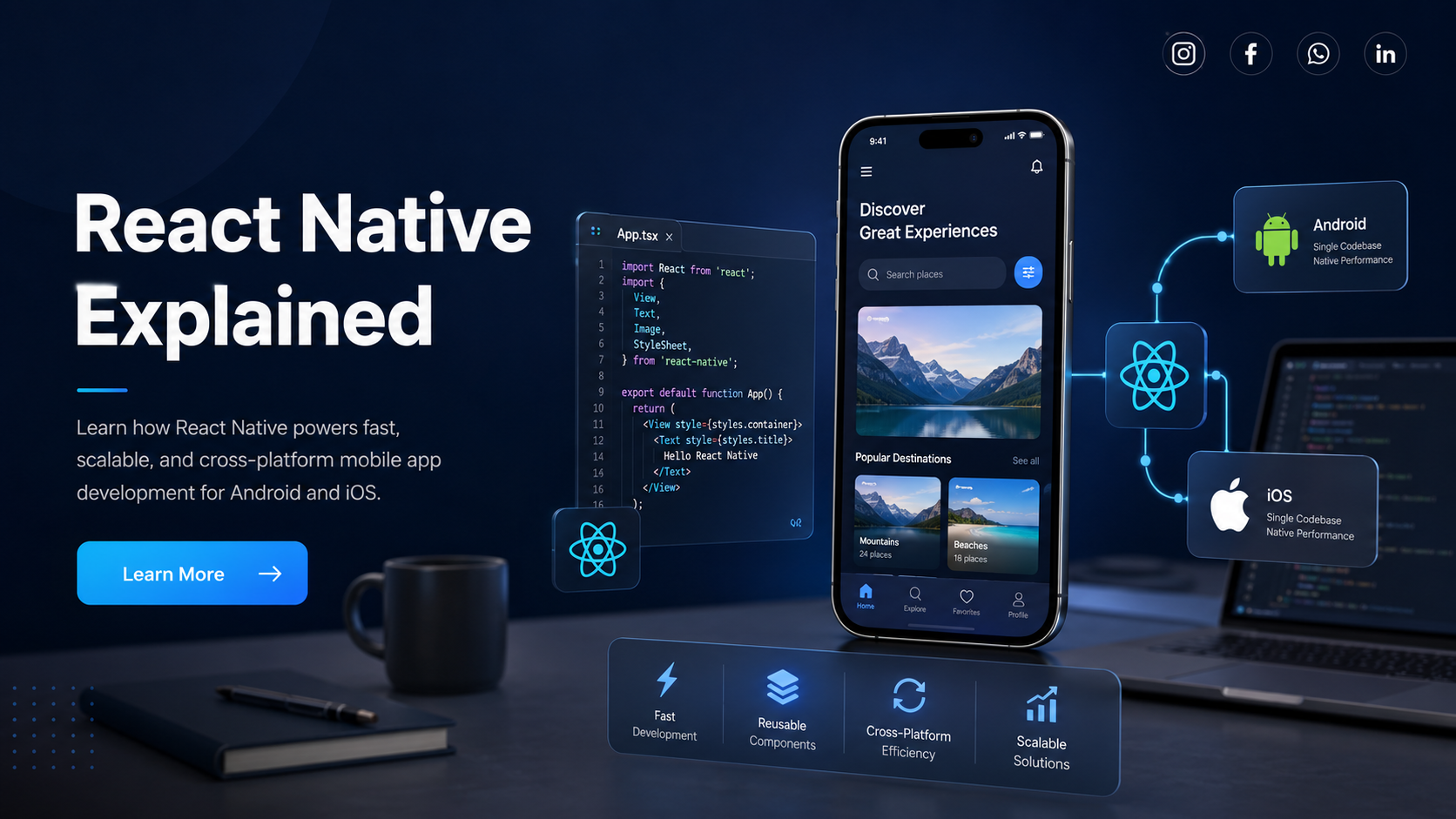
React Native is one of the most popular frameworks for building cross-platform mobile applications. It enables developers to create apps for both Android and iOS using a single codebase, helping businesses reduce development costs, accelerate project timelines, and reach users on multiple platforms more efficiently.
Whether you’re a business owner exploring mobile app development options or a developer looking to understand modern frameworks, learning how React Native works can help you make informed decisions.
In this guide, we’ll explore what React Native is, how it works, its key features, advantages, limitations, use cases, and why it continues to be a preferred choice for modern mobile app development.
What is React Native?
React Native is an open-source mobile application development framework created by Meta. It allows developers to build mobile applications for Android and iOS using JavaScript and React.
Unlike traditional native app development, where separate codebases are required for Android and iOS, React Native enables developers to write a significant portion of the code once and deploy it across multiple platforms.
The framework was introduced to solve a common challenge faced by businesses and development teams: maintaining separate development efforts for different operating systems. By using React Native, companies can streamline development while still delivering a native-like user experience.
Today, React Native powers thousands of mobile applications worldwide and is widely adopted by startups, enterprises, and technology companies seeking efficient cross-platform app development solutions.
Who Developed React Native?
React Native was developed by Meta, formerly known as Facebook. The framework was first introduced in 2015 after Facebook engineers sought a way to improve development efficiency across multiple mobile platforms.
The goal was simple: create a framework that combines the flexibility of web development with the performance and experience of native mobile applications.
Since its launch, React Native has evolved significantly through continuous improvements, community contributions, and support from organizations worldwide. Its strong ecosystem and active developer community have played a major role in its widespread adoption.

Why Has React Native Become So Popular?
The popularity of React Native is driven by its ability to address several challenges associated with mobile app development.
Businesses often want applications available on both Android and iOS. Developing separate native applications can double development efforts, increase costs, and extend project timelines.
React Native offers a practical solution by enabling cross-platform app development through a shared codebase. This approach allows businesses to launch products faster while maintaining a consistent user experience across devices.
Several additional factors contribute to its popularity:
- Faster development cycles
- Lower development costs
- Strong community support
- Extensive third-party libraries
- Near-native performance
- Simplified maintenance
These advantages have made React Native a preferred choice for organizations seeking scalable mobile app development solutions.
How Does React Native Work?
Understanding how React Native works is important for both developers and business decision-makers.
At its core, React Native uses JavaScript to create application logic while leveraging native platform components to render the user interface.
When users interact with a React Native application, the framework communicates between JavaScript code and native platform code, ensuring the app functions properly on Android and iOS devices.
Instead of displaying web views like some hybrid frameworks, React Native renders actual native UI components. This is one of the key reasons why React Native applications feel more responsive and natural to users.
In simple terms, React Native acts as a bridge between JavaScript code and the native capabilities of mobile operating systems.
This architecture allows developers to build feature-rich applications while minimizing the need to write separate platform-specific code.
Understanding React Native Architecture
React Native architecture consists of multiple layers working together to create a seamless user experience.
The primary components include:
JavaScript Layer
This is where most application logic is written. Developers create user interfaces, manage application states, handle data processing, and implement business logic using JavaScript.
Native Layer
The native layer interacts directly with Android and iOS operating systems. It handles device-specific functionality such as camera access, GPS, notifications, and hardware integrations.
Bridge Communication
Traditionally, React Native used a bridge mechanism to enable communication between JavaScript and native code.
The bridge transfers information between the two environments, allowing developers to access native device features while working primarily with JavaScript.
New Architecture
React Native’s newer architecture improves performance, reduces communication bottlenecks, and enhances responsiveness.
This advancement helps applications run more smoothly while providing better scalability for complex projects.
Key Features of React Native
React Native offers several features that make it attractive for mobile app development projects.
Cross-Platform Development
One of the biggest advantages of React Native is its ability to support both Android and iOS using a shared codebase.
This significantly reduces development effort and accelerates project delivery.
Code Reusability
Developers can reuse a substantial portion of their code across platforms.
This improves productivity while reducing maintenance requirements.
Hot Reloading
Hot Reloading allows developers to see changes instantly without restarting the application.
This feature speeds up development and testing processes.
Large Community Support
React Native has one of the largest developer communities in the mobile development ecosystem.
Developers have access to countless resources, plugins, libraries, tutorials, and community-driven solutions.
Native Performance
Because React Native uses native components instead of web views, applications often deliver better performance compared to many traditional hybrid frameworks.
Third-Party Integration
React Native supports integration with numerous APIs, tools, and third-party services, making it suitable for complex business applications.
Benefits of React Native for Businesses
From a business perspective, React Native offers several compelling advantages.
Faster Time to Market
Speed is often critical in competitive markets.
React Native enables development teams to build and launch applications more quickly by sharing code across platforms.
This faster development cycle helps businesses validate ideas, gather user feedback, and respond to market opportunities efficiently.
Reduced Development Costs
Building separate Android and iOS applications can significantly increase development expenses.
React Native helps reduce these costs by allowing a single team to manage much of the development process through one codebase.
For startups and growing businesses, this can result in substantial savings.
Easier Maintenance
Maintaining multiple applications can become complex and resource-intensive.
With React Native, updates and improvements can often be implemented simultaneously across both platforms, simplifying long-term maintenance.
Improved Scalability
React Native supports scalable application architectures, making it suitable for businesses planning future growth.
As user demands increase, developers can extend functionality without rebuilding the application from scratch.
Consistent User Experience
Consistency is important for brand perception and customer satisfaction.
React Native helps ensure users receive a similar experience regardless of whether they use Android or iOS devices.
Advantages and Disadvantages of React Native
Like any technology, React Native has strengths and limitations.
Advantages of React Native
React Native offers faster development, lower costs, code reusability, strong community support, and near-native performance. These benefits make it an excellent choice for many business applications, startup projects, and enterprise solutions.
Additionally, the framework continues to evolve, providing access to modern features and improved development capabilities.
Disadvantages of React Native
While React Native works exceptionally well for many projects, certain applications may require extensive native functionality.
Complex graphics-intensive applications, advanced gaming platforms, and highly specialized device integrations may sometimes benefit from fully native development approaches.
Businesses should evaluate project requirements carefully before selecting a development framework.
When React Native May Not Be the Right Choice
If an application requires extremely high-performance graphics rendering, intensive real-time processing, or deep platform-specific customization, native app development may provide better results.
However, for most business applications, ecommerce platforms, service marketplaces, healthcare apps, fintech solutions, and enterprise tools, React Native remains a highly effective option.
React Native vs Native App Development
One of the most common questions businesses ask is whether they should choose React Native or native app development.
Native app development involves building separate applications for Android and iOS using platform-specific programming languages. Android applications are typically developed using Kotlin or Java, while iOS applications are built using Swift or Objective-C.
React Native takes a different approach by allowing developers to use a shared codebase for both platforms.
For businesses focused on cost efficiency, faster development, and quicker market entry, React Native often provides a significant advantage. A single development team can build and maintain applications for both Android and iOS, reducing overall project complexity.
Native development may still be the preferred option for applications requiring extensive hardware interaction, advanced graphics processing, or highly platform-specific features. However, for most business applications, ecommerce platforms, healthcare solutions, logistics systems, fintech products, and customer-facing mobile apps, React Native delivers an excellent balance between performance and development efficiency.
The decision ultimately depends on project goals, budget, timeline, and long-term scalability requirements.

React Native vs Flutter
Another frequently asked question is how React Native compares to Flutter.
Both frameworks are designed for cross-platform mobile app development, but they use different technologies and development approaches.
React Native uses JavaScript and React, making it particularly attractive to businesses and development teams already familiar with modern web development.
Flutter, developed by Google, uses the Dart programming language and provides its own rendering engine.
React Native often benefits from its mature ecosystem, extensive community support, and easier adoption among developers who already work with JavaScript. Flutter is known for highly customizable user interfaces and consistent visual rendering across devices.
From a business perspective, both frameworks are strong choices. However, React Native frequently becomes the preferred option because of its larger talent pool, established market presence, and widespread industry adoption.
Organizations seeking long-term flexibility and access to experienced developers often find React Native to be a practical investment.
What Types of Apps Can Be Built with React Native?
One reason React Native continues to grow in popularity is its versatility.
The framework can be used to build a wide range of mobile applications across different industries.
Ecommerce Applications
Modern ecommerce businesses require mobile experiences that are fast, intuitive, and scalable.
React Native enables businesses to develop shopping apps with product catalogs, secure payment gateways, order tracking, customer accounts, and personalized recommendations.
Healthcare Applications
Healthcare organizations use React Native to build patient portals, telemedicine platforms, appointment scheduling systems, and health monitoring applications.
Fintech Solutions
Financial technology companies often use React Native for mobile banking, digital wallets, payment processing platforms, investment applications, and financial management tools.
Logistics and Transportation Apps
React Native supports applications that require GPS tracking, route optimization, delivery management, fleet monitoring, and real-time notifications.
On-Demand Service Platforms
Businesses offering food delivery, ride-sharing, home services, and booking solutions frequently choose React Native because of its ability to support scalable and feature-rich applications.
Enterprise Applications
Large organizations use React Native for internal tools, employee management systems, workflow automation platforms, and business productivity applications.
Popular Apps Built with React Native
The adoption of React Native by major companies demonstrates its reliability and effectiveness.
Some well-known applications that have utilized React Native include:
- Shopify
These organizations selected React Native because it allowed them to improve development efficiency while delivering high-quality user experiences.
The success of these applications highlights React Native’s ability to support projects ranging from startups to enterprise-scale platforms.
Is React Native Good for Startups?
For startups, resources are often limited, making technology decisions especially important.
React Native offers several advantages that align well with startup requirements.
First, it reduces development costs by minimizing duplicate work across platforms. Instead of building separate Android and iOS applications, startups can launch on both platforms using a shared codebase.
Second, React Native accelerates product development. This enables startups to launch minimum viable products (MVPs) faster, gather user feedback, and iterate based on real market demand.
Third, React Native supports scalability. As a startup grows, the framework can continue supporting new features, integrations, and expanding user bases.
For many startups, React Native provides an ideal combination of affordability, speed, and long-term flexibility.
Is React Native Suitable for Enterprise Applications?
Many decision-makers assume React Native is primarily designed for startups. In reality, it is also widely used in enterprise environments.
Large organizations choose React Native because it supports scalable architectures, robust integrations, and efficient maintenance processes.
Enterprise applications often require:
- Secure authentication systems
- Complex business workflows
- Third-party integrations
- Real-time data synchronization
- Performance optimization
- Continuous updates
React Native is capable of supporting these requirements when implemented using proper development practices.
As a result, it has become a trusted framework for organizations seeking efficient enterprise mobile app development solutions.

React Native Development Process
A successful React Native project typically follows a structured development process.
The first stage involves understanding business objectives, user requirements, and project goals. This discovery phase helps define the application’s functionality and overall scope.
Next comes UI/UX design, where designers create intuitive interfaces that align with user expectations and business branding.
During development, engineers build application features, integrate APIs, implement business logic, and ensure cross-platform compatibility.
Testing follows development and includes functionality testing, performance testing, security validation, and user experience evaluation.
Once testing is completed, the application is deployed to app stores and made available to users.
The final stage involves ongoing maintenance, updates, performance improvements, and feature enhancements.
Following this process helps ensure a stable and scalable mobile application.
Common Challenges in React Native Development
Although React Native offers many advantages, developers may encounter certain challenges.
Performance optimization can become important for applications that process large amounts of data or require complex animations.
Managing third-party dependencies may occasionally create compatibility issues during framework updates.
Native module integration can also require additional expertise when applications need advanced platform-specific functionality.
Device fragmentation presents another challenge because Android devices vary significantly in screen sizes, hardware capabilities, and operating system versions.
Fortunately, experienced React Native developers can address these challenges through proper planning, architecture design, and testing strategies.
Best Practices for React Native Development
To maximize application performance and maintainability, development teams should follow established best practices.
Reusable components should be implemented whenever possible to improve code quality and development efficiency.
Performance optimization techniques such as lazy loading, efficient state management, and image optimization can significantly enhance user experience.
Security should remain a priority throughout development, including secure authentication mechanisms, encrypted data storage, and protected API communications.
Keeping dependencies updated helps reduce security risks and ensures compatibility with newer platform versions.
Clean code principles, comprehensive testing, and scalable architecture design also contribute to long-term project success.
Future of React Native
The future of React Native looks promising as demand for cross-platform app development continues to grow.
Businesses increasingly seek development solutions that reduce costs while maintaining high-quality user experiences. React Native aligns perfectly with these objectives.
The framework’s ongoing architectural improvements are enhancing performance, scalability, and developer productivity.
As mobile applications become more sophisticated, React Native continues evolving to support modern business requirements and emerging technologies.
Its strong community, extensive ecosystem, and widespread industry adoption suggest that React Native will remain a leading mobile development framework for years to come.
Frequently Asked Questions
Q1. What is React Native used for?
React Native is used to build cross-platform mobile applications for Android and iOS using a shared codebase. It is commonly used for ecommerce apps, healthcare solutions, fintech products, enterprise applications, and on-demand service platforms.
Q2. How does React Native work?
React Native uses JavaScript to manage application logic while rendering native user interface components. This allows developers to create applications that feel and perform similarly to native mobile apps.
Q3. Is React Native better than Flutter?
Both frameworks are strong choices for cross-platform development. React Native often appeals to organizations already using JavaScript and React, while Flutter is known for UI customization capabilities. The best choice depends on project requirements.
Q4. Can React Native build both Android and iOS applications?
Yes. React Native enables developers to create applications for both Android and iOS using a largely shared codebase, reducing development time and costs.
Q5. Is React Native suitable for startups?
Yes. React Native helps startups reduce development expenses, launch products faster, and scale applications efficiently as their businesses grow.
Q6. Which companies use React Native?
Many well-known organizations use React Native, including Instagram, Facebook, Shopify, and numerous startups and enterprise businesses worldwide.
Q7. What are the main benefits of React Native?
The primary benefits include faster development, lower costs, code reusability, cross-platform compatibility, easier maintenance, and strong community support.
Conclusion
React Native has transformed modern mobile app development by providing an efficient way to build high-quality applications for both Android and iOS using a single codebase.
For businesses, it offers a powerful combination of speed, cost efficiency, scalability, and user experience. For developers, it provides access to a mature ecosystem, extensive community resources, and flexible development capabilities.
Whether you’re launching a startup MVP, building an enterprise mobility solution, developing an ecommerce application, or creating a customer engagement platform, React Native remains one of the most practical and widely adopted frameworks available today.
As organizations continue investing in digital transformation and mobile-first experiences, React Native is expected to remain a key technology for delivering scalable, high-performance mobile applications that meet modern business demands.
Looking for React Native App Development Services?
If you’re planning to build a cross-platform mobile application, partnering with an experienced React Native development company can help you reduce development costs, accelerate time to market, and deliver a seamless user experience across Android and iOS devices.
From startup MVPs and ecommerce platforms to enterprise applications and custom business solutions, the right development team can help transform your idea into a scalable, feature-rich mobile application that supports long-term business growth.


