
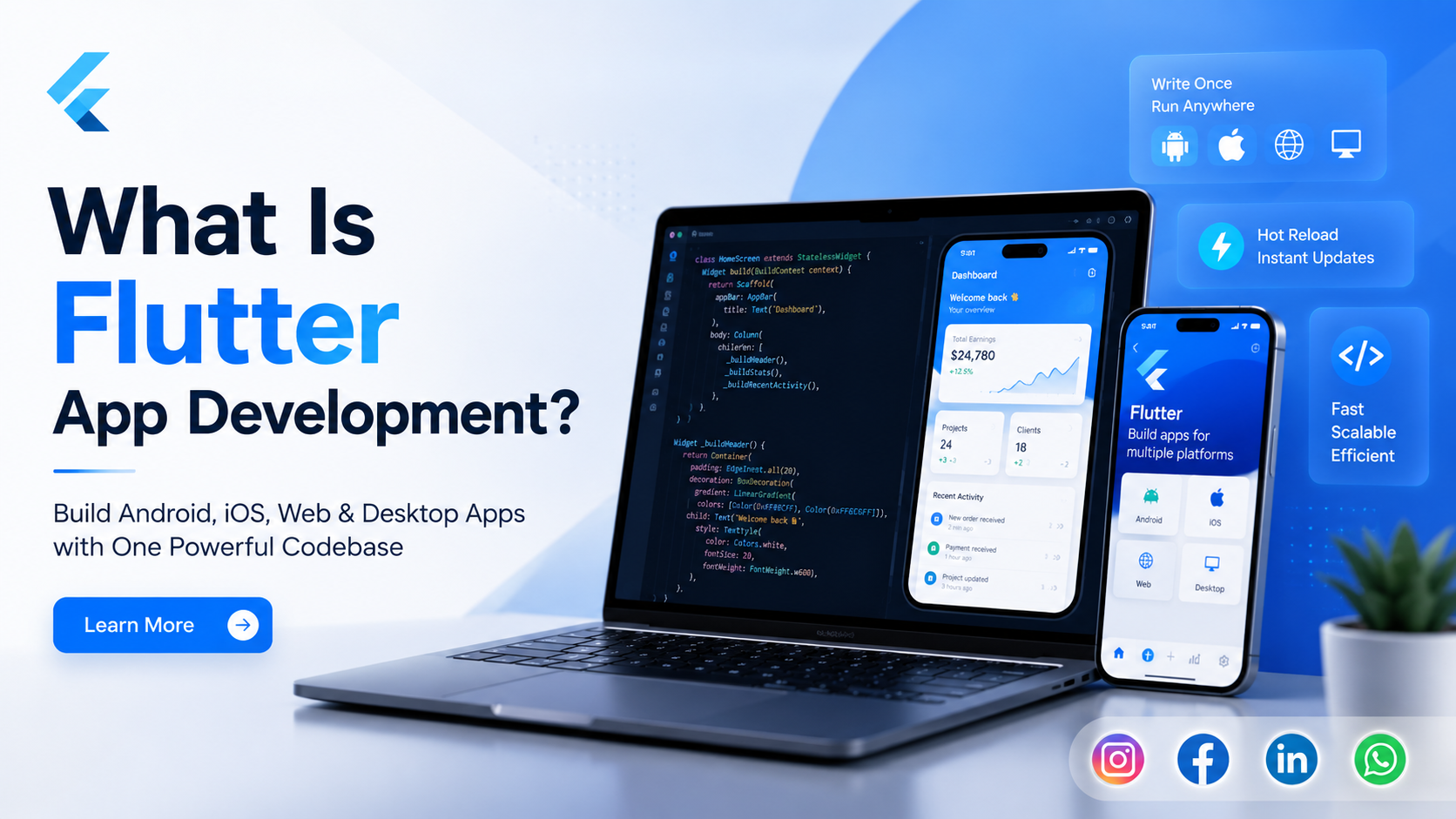
Building an application today is no longer limited to creating separate versions for Android, iOS, web, and desktop platforms. Businesses want faster development, lower costs, and the ability to reach users across multiple devices without maintaining different codebases. This is where Flutter App Development has become one of the most popular choices in modern software development.
Whether you are a startup launching a new product, a growing business expanding digital services, or an enterprise looking to streamline development, Flutter offers a practical way to build high-quality applications efficiently.
If you have heard the term Flutter but are unsure what it actually means, this guide explains everything in simple language. You will learn what Flutter is, how Flutter App Development works, its benefits, use cases, comparisons with other technologies, and why businesses around the world are increasingly adopting it for mobile and cross-platform application development.
What is Flutter?
Flutter is an open-source UI software development framework created by Google that allows developers to build applications for multiple platforms using a single codebase. Instead of writing separate code for Android, iOS, web, and desktop applications, developers can write one set of code and deploy it across different platforms.
The framework was introduced to solve one of the biggest challenges in software development: the need to maintain multiple versions of the same application for different operating systems.
Traditionally, a business that wanted both an Android app and an iPhone app needed two separate development teams or two different codebases. This increased development costs, extended project timelines, and made maintenance more complicated. Flutter simplifies this process by enabling developers to create applications for multiple platforms from a single project.
Today, Flutter is widely used by startups, enterprises, software development companies, and technology-driven businesses looking for a cost-effective and scalable application development solution.
What is Flutter App Development?
Flutter App Development is the process of creating mobile, web, desktop, and cross-platform applications using the Flutter framework.
In simple terms, developers use Flutter to build an application once and run it on multiple devices and operating systems. The application’s user interface, functionality, and business logic are written within a single codebase, which significantly reduces development effort and maintenance costs.
For example, imagine a business wants to launch an e-commerce application. Instead of creating separate Android and iOS versions, developers can build one Flutter application that works across both platforms while delivering a consistent user experience.
This approach allows businesses to launch products faster, reduce development expenses, and maintain feature consistency across devices.
Why Was Flutter Created?
Before Flutter, businesses often faced several challenges when developing applications for multiple platforms.
Creating separate applications meant:
- Higher development costs
- Longer project timelines
- More testing requirements
- Complex maintenance processes
- Feature inconsistencies between platforms
Google developed Flutter to address these issues by providing a single framework capable of building visually attractive, high-performance applications for multiple platforms.
The goal was simple: help developers create beautiful applications faster while helping businesses reduce development complexity.

How Flutter App Development Works
To understand Flutter App Development, it helps to look at the basic components that work together behind the scenes.
Developers write application code using Dart, the programming language used by Flutter. The Flutter framework then uses its rendering engine to display the application’s interface consistently across different platforms.
Unlike many cross-platform frameworks that rely heavily on native UI components, Flutter draws its own interface elements. This gives developers greater control over design, performance, and user experience.
The result is an application that looks and behaves consistently whether it is running on Android, iOS, web browsers, Windows, macOS, or Linux systems.
Key Components of Flutter
Flutter SDK
The Flutter Software Development Kit (SDK) provides all the tools needed to design, build, test, and deploy applications. It acts as the foundation of the entire Flutter ecosystem.
Dart Programming Language
Flutter applications are built using Dart. The language is designed for high performance and helps developers create responsive applications with modern programming features.
Widgets
Widgets are the building blocks of every Flutter application. Everything users see on the screen, including buttons, menus, forms, navigation bars, and layouts, is created using widgets.
This widget-based architecture allows developers to create highly customized and visually appealing interfaces.
Flutter Engine
The Flutter Engine handles graphics rendering, animation processing, text display, and application performance optimization. It plays a crucial role in delivering smooth and responsive user experiences.
Hot Reload
One of Flutter’s most appreciated features is Hot Reload. It allows developers to instantly view code changes without restarting the application, significantly speeding up development and testing processes.
Why Flutter App Development Has Become So Popular
The growing popularity of Flutter is not accidental. Businesses are constantly searching for ways to reduce costs while delivering high-quality digital products, and Flutter addresses both objectives effectively.
One of the biggest reasons behind Flutter’s success is its ability to support multiple platforms through a single codebase. This reduces development effort and allows businesses to launch applications much faster than traditional development methods.
Another major advantage is the flexibility Flutter provides for creating visually attractive user interfaces. Businesses can build custom experiences that align with their branding while maintaining consistent functionality across devices.
Developers also appreciate Flutter because it simplifies maintenance. Updates, bug fixes, and feature enhancements can often be implemented once and distributed across all supported platforms.
For businesses, this translates into lower long-term costs and faster product improvements.
Key Benefits of Flutter App Development for Businesses
From a business perspective, Flutter offers several practical advantages.
Development costs are often lower because one team can manage multiple platforms through a unified codebase. This reduces resource requirements and improves operational efficiency.
Time-to-market is another significant benefit. Businesses can release products faster, gather user feedback sooner, and respond to market demands more effectively.
Flutter also supports scalability. Whether a company is building a simple startup application or a complex enterprise platform, Flutter provides the flexibility needed to support future growth.
The framework’s ability to deliver consistent user experiences across devices further strengthens brand credibility and customer satisfaction.
These advantages make Flutter particularly attractive for startups, SaaS companies, e-commerce businesses, healthcare platforms, logistics providers, educational applications, and enterprise software solutions.
What Platforms Can Be Built Using Flutter?
One of the biggest reasons businesses choose Flutter App Development is its ability to support multiple platforms from a single codebase.
Instead of investing in separate development projects for each operating system, organizations can build and manage applications more efficiently while maintaining a consistent experience across devices.
Android Applications
Flutter is widely used for Android app development. Applications built with Flutter can access device features such as cameras, GPS, notifications, biometric authentication, and local storage while maintaining high performance.
Whether it’s a business app, e-commerce platform, healthcare solution, or logistics application, Flutter provides the tools needed to create feature-rich Android experiences.
iOS Applications
Flutter also supports iPhone and iPad application development. Businesses can create iOS applications that follow Apple’s design standards while maintaining a shared codebase with Android versions.
This significantly reduces development and maintenance efforts compared to traditional native development.
Web Applications
Flutter has expanded beyond mobile development and now supports web application development.
Businesses can create customer portals, internal dashboards, SaaS platforms, booking systems, and business management applications using Flutter Web.
This capability allows organizations to deliver a unified experience across both mobile and browser environments.
Desktop Applications
Flutter supports Windows, macOS, and Linux application development.
Desktop applications built with Flutter are increasingly used for business management systems, enterprise software, productivity tools, and internal operational platforms.
Progressive Web Applications (PWAs)
Flutter can also be used to build Progressive Web Apps, allowing businesses to deliver app-like experiences directly through web browsers without requiring traditional installation.
What Types of Apps Can Be Built Using Flutter?
A common question businesses ask is whether Flutter is suitable for their industry.
The answer is usually yes.
Flutter’s flexibility allows it to support a wide variety of application types across different business sectors.
E-Commerce Applications
Online stores, marketplace platforms, inventory management systems, and customer shopping applications can all be built using Flutter.
Features such as product catalogs, payment integration, customer accounts, order tracking, and push notifications work effectively within Flutter applications.
Healthcare Applications
Healthcare providers increasingly use Flutter to develop appointment booking systems, telemedicine platforms, patient management applications, and healthcare information portals.
Education Applications
Learning management systems, online course platforms, student portals, virtual classrooms, and educational mobile applications can all benefit from Flutter’s cross-platform capabilities.
Financial and FinTech Applications
Flutter is often used for digital banking solutions, payment applications, financial management platforms, investment tools, and budgeting applications.
Logistics and Transportation Applications
Businesses in transportation and logistics frequently use Flutter for shipment tracking systems, fleet management applications, warehouse solutions, and customer delivery portals.
SaaS Applications
Software-as-a-Service companies often choose Flutter to develop scalable products that operate across mobile, web, and desktop environments.
Enterprise Applications
Large organizations use Flutter for CRM systems, ERP platforms, employee management solutions, workflow automation tools, and business intelligence applications.

Flutter App Development Process
Understanding the development process helps businesses know what to expect when building a Flutter application.
While every project is unique, most Flutter development projects follow a similar workflow.
Requirement Analysis
The process begins by identifying business goals, target users, required features, technical requirements, and project objectives.
This stage lays the foundation for successful application development.
UI/UX Design
Once requirements are finalized, designers create wireframes and user interface designs that define the application’s appearance and user journey.
Flutter’s widget-based architecture makes it particularly effective for creating visually attractive interfaces.
Application Architecture Planning
Developers plan the application’s structure, database requirements, APIs, integrations, security measures, and scalability considerations.
Proper planning ensures long-term maintainability and performance.
Flutter Development
The development team begins building the application using Flutter and Dart.
Core features, user interfaces, backend integrations, and business logic are implemented during this phase.
Testing and Quality Assurance
Every application undergoes extensive testing to identify bugs, performance issues, usability concerns, and security vulnerabilities.
Testing ensures the final product delivers a reliable user experience.
Deployment
After successful testing, the application is launched on the appropriate platforms, including Google Play Store, Apple App Store, web servers, or desktop distribution channels.
Ongoing Maintenance
Post-launch support includes performance monitoring, feature enhancements, security updates, bug fixes, and future improvements.
Flutter vs Native App Development
Businesses often compare Flutter with traditional native app development before making a technology decision.
Native development involves building separate applications for Android and iOS using platform-specific technologies.
Flutter takes a different approach by enabling developers to create both versions using a single codebase.
For businesses focused on cost efficiency and faster market entry, Flutter often provides significant advantages.
Native development may still be preferred when applications require highly specialized platform-specific functionality or intensive hardware integrations.
However, for most business applications, Flutter delivers an excellent balance of performance, scalability, and development efficiency.
Flutter vs React Native
Flutter and React Native are two of the most popular cross-platform development frameworks available today.
While both aim to simplify multi-platform development, they differ in several important ways.
Flutter uses Dart and provides its own rendering engine, allowing developers to create highly customized user interfaces with consistent performance across platforms.
React Native relies on JavaScript and bridges communication with native platform components.
Many developers choose Flutter because of its strong UI capabilities, predictable rendering, extensive widget ecosystem, and fast development workflow.
Ultimately, the right choice depends on project requirements, team expertise, and long-term business goals.
Is Flutter Good for Startups?
For startups, speed and cost efficiency are often critical factors.
Flutter helps startups launch products faster because developers can build Android and iOS applications simultaneously.
This allows founders to validate ideas, gather user feedback, and reach the market more quickly.
Lower development costs also make Flutter attractive for startups working with limited budgets.
As the business grows, Flutter’s scalability supports future expansion without requiring a complete technology overhaul.
For many startups, Flutter provides an ideal balance between affordability, speed, and long-term flexibility.

Is Flutter Good for Enterprise Applications?
Many people assume Flutter is only suitable for startups, but that perception is no longer accurate.
Today, enterprise organizations increasingly adopt Flutter for large-scale application development.
Flutter supports robust architecture patterns, secure authentication systems, cloud integrations, API connectivity, analytics platforms, and enterprise-grade workflows.
Its ability to maintain a unified codebase across platforms can significantly reduce operational complexity for large organizations.
Enterprises also benefit from faster feature deployment cycles, easier maintenance, and lower long-term development costs.
For organizations focused on digital transformation, Flutter has become a serious enterprise technology option.
Popular Applications Built Using Flutter
One reason Flutter has gained credibility in the software development industry is that it is used by organizations ranging from startups to global enterprises.
Businesses across industries rely on Flutter to deliver consistent digital experiences across multiple platforms.
Large-scale organizations appreciate Flutter’s ability to reduce development complexity while maintaining performance and design consistency.
The growing adoption of Flutter demonstrates that it is no longer considered an experimental framework. It has matured into a reliable technology capable of supporting business-critical applications.
For organizations evaluating development technologies, real-world adoption provides confidence that Flutter can support long-term business objectives.
Advantages of Flutter App Development
Flutter continues to gain popularity because it solves many of the challenges businesses face when developing applications.
One of its greatest strengths is development efficiency. Instead of managing separate Android and iOS projects, businesses can streamline development through a unified codebase.
Another major advantage is consistency. Applications look and behave similarly across platforms, helping businesses maintain a strong brand experience.
Flutter also supports rapid development cycles. Features can be released faster, updates become easier to manage, and businesses can respond to changing market conditions more effectively.
The framework offers exceptional flexibility for creating custom user interfaces. Companies that want unique, visually appealing applications often find Flutter particularly attractive.
Performance is another key benefit. Flutter applications can deliver smooth animations, responsive interactions, and a high-quality user experience that closely resembles native applications.
Perhaps most importantly, Flutter helps businesses optimize development budgets while still delivering professional, scalable software solutions.
Potential Limitations of Flutter
No technology is perfect, and Flutter is no exception.
Understanding potential limitations helps businesses make informed decisions.
One consideration is application size. Flutter applications may sometimes have larger installation sizes compared to fully native applications.
Another factor is platform-specific functionality. While Flutter supports most common features, highly specialized hardware integrations may occasionally require additional native development work.
Organizations new to Flutter may also need developers familiar with Dart, the programming language used by the framework.
However, for most business applications, these limitations are relatively minor compared to the advantages Flutter provides.
The key is evaluating project requirements carefully before selecting any technology stack.
How Much Does Flutter App Development Cost?
One of the most frequently asked questions about Flutter App Development cost.
The reality is that development costs vary significantly depending on project complexity, required features, integrations, design requirements, and business objectives.
Simple applications with basic functionality typically require less investment than enterprise-grade platforms with advanced workflows, integrations, and security requirements.
Several factors influence Flutter development costs:
- Application complexity
- Number of features
- UI/UX design requirements
- Third-party integrations
- Backend infrastructure
- Security requirements
- Testing scope
- Maintenance needs
Because Flutter supports cross-platform development through a single codebase, businesses can often reduce overall development expenses compared to maintaining separate Android and iOS projects.
This cost efficiency is one of the primary reasons startups and growing businesses choose Flutter.
How Long Does Flutter App Development Take?
Development timelines depend on project scope and complexity.
A simple application may take a few weeks to complete, while larger business applications can require several months of development.
Flutter’s single-codebase approach often accelerates development because teams are not building multiple platform versions separately.
The timeline typically depends on:
- Project requirements
- Feature complexity
- Design customization
- API integrations
- Testing requirements
- Regulatory or compliance considerations
For many organizations, Flutter enables faster time-to-market compared to traditional development approaches.
Is Flutter Secure?
Security is a critical consideration for modern applications.
Flutter provides access to industry-standard security practices including secure authentication, encrypted communication, API protection, data storage security, and access control mechanisms.
However, application security ultimately depends on how the software is designed, developed, tested, and maintained.
When implemented correctly, Flutter can support secure applications across industries including healthcare, finance, logistics, education, and enterprise software.
Is Flutter Good for SEO?
This question commonly arises when businesses plan to build web applications.
Flutter Web can support SEO strategies, but implementation requires proper planning.
Search engine visibility depends on factors such as content accessibility, rendering methods, metadata optimization, structured data, page performance, and overall technical SEO configuration.
For content-heavy websites, businesses should carefully evaluate SEO requirements before selecting any web technology.
For web applications, dashboards, portals, SaaS platforms, and interactive systems, Flutter Web can be an effective solution.
The Future of Flutter App Development in 2026 and Beyond
Flutter continues to evolve rapidly and remains one of the most important technologies in cross-platform software development.
Several factors contribute to its long-term potential.
Businesses increasingly seek cost-efficient development solutions that support multiple platforms without sacrificing quality.
Cross-platform development is becoming a strategic priority for organizations looking to maximize technology investments.
Flutter’s growing ecosystem, expanding developer community, enterprise adoption, and continued support position it as a strong option for future application development projects.
The rise of AI-powered applications, cloud-based platforms, SaaS solutions, and digital transformation initiatives is also creating new opportunities for Flutter.
As businesses continue expanding their digital presence across mobile, web, and desktop environments, Flutter is likely to remain a major development framework for years to come.
Who Should Choose Flutter App Development?
Flutter is particularly well suited for organizations that want to reach multiple platforms while controlling development costs and accelerating delivery timelines.
It is often an excellent choice for:
Startups seeking rapid product launches.
Growing businesses expanding digital services.
SaaS companies building cross-platform software products.
E-commerce businesses serving customers across multiple devices.
Healthcare organizations developing patient-focused applications.
Educational institutions creating learning platforms.
Logistics companies improving operational visibility.
Enterprises modernizing internal systems and customer experiences.
The suitability of Flutter ultimately depends on project requirements, but for many business scenarios, it offers a highly practical and scalable solution.
Frequently Asked Questions About Flutter App Development
What is Flutter App Development?
Flutter App Development is the process of creating mobile, web, and desktop applications using Flutter, an open-source framework that enables developers to build multiple platforms from a single codebase.
Is Flutter a programming language?
No. Flutter is a software development framework. It uses Dart as its programming language.
Which programming language does Flutter use?
Flutter applications are developed using Dart.
Is Flutter free to use?
Yes. Flutter is open-source and available for businesses and developers to use without licensing costs.
Can Flutter build Android and iOS apps?
Yes. Flutter supports both Android and iOS application development from a single codebase.
Can Flutter build web applications?
Yes. Flutter supports web application development, including business portals, dashboards, and SaaS platforms.
Can Flutter build desktop applications?
Yes. Flutter supports Windows, macOS, and Linux desktop applications.
Is Flutter better than React Native?
The answer depends on project requirements. Flutter is often preferred for highly customized interfaces and consistent rendering across platforms, while React Native may be preferred by teams already experienced with JavaScript.
Is Flutter better than Native App Development?
Neither approach is universally better. Flutter excels in cross-platform efficiency, while native development may be advantageous for highly specialized platform-specific applications.
Is Flutter suitable for startups?
Yes. Flutter helps startups reduce development costs, accelerate launches, and validate ideas faster.
Is Flutter suitable for enterprise applications?
Yes. Many enterprises use Flutter for scalable, secure, and maintainable business applications.
What are the biggest benefits of Flutter?
The main benefits include faster development, lower costs, cross-platform compatibility, easier maintenance, and consistent user experiences.
What are the disadvantages of Flutter?
Potential limitations include larger application sizes, occasional platform-specific development requirements, and the need for Dart expertise.
How much does Flutter App Development cost?
Costs vary depending on project complexity, features, integrations, and business requirements.
How long does it take to build a Flutter application?
Development timelines range from a few weeks for simple applications to several months for complex enterprise solutions.
Is Flutter secure?
Yes. Flutter supports modern security practices when implemented properly.
Is Flutter still relevant in 2026?
Absolutely. Flutter remains one of the leading cross-platform development frameworks and continues to grow in adoption.
What types of applications can be built with Flutter?
Flutter can be used to develop e-commerce apps, healthcare platforms, educational systems, SaaS products, logistics solutions, fintech applications, enterprise software, and many other digital products.
Why do businesses choose Flutter?
Businesses choose Flutter because it helps reduce development costs, accelerate time-to-market, simplify maintenance, and support multiple platforms through a single codebase.
Conclusion
Flutter App Development has transformed the way modern applications are built. By allowing developers to create Android, iOS, web, and desktop applications from a single codebase, Flutter helps businesses reduce complexity, control costs, and launch products faster.
Whether you are a startup building your first MVP, a growing company expanding digital services, or an enterprise pursuing digital transformation, Flutter offers a powerful combination of flexibility, performance, scalability, and efficiency.
As cross-platform development continues to shape the future of software development, Flutter remains one of the most practical and future-ready technologies available to businesses looking to create high-quality applications across multiple platforms.


