
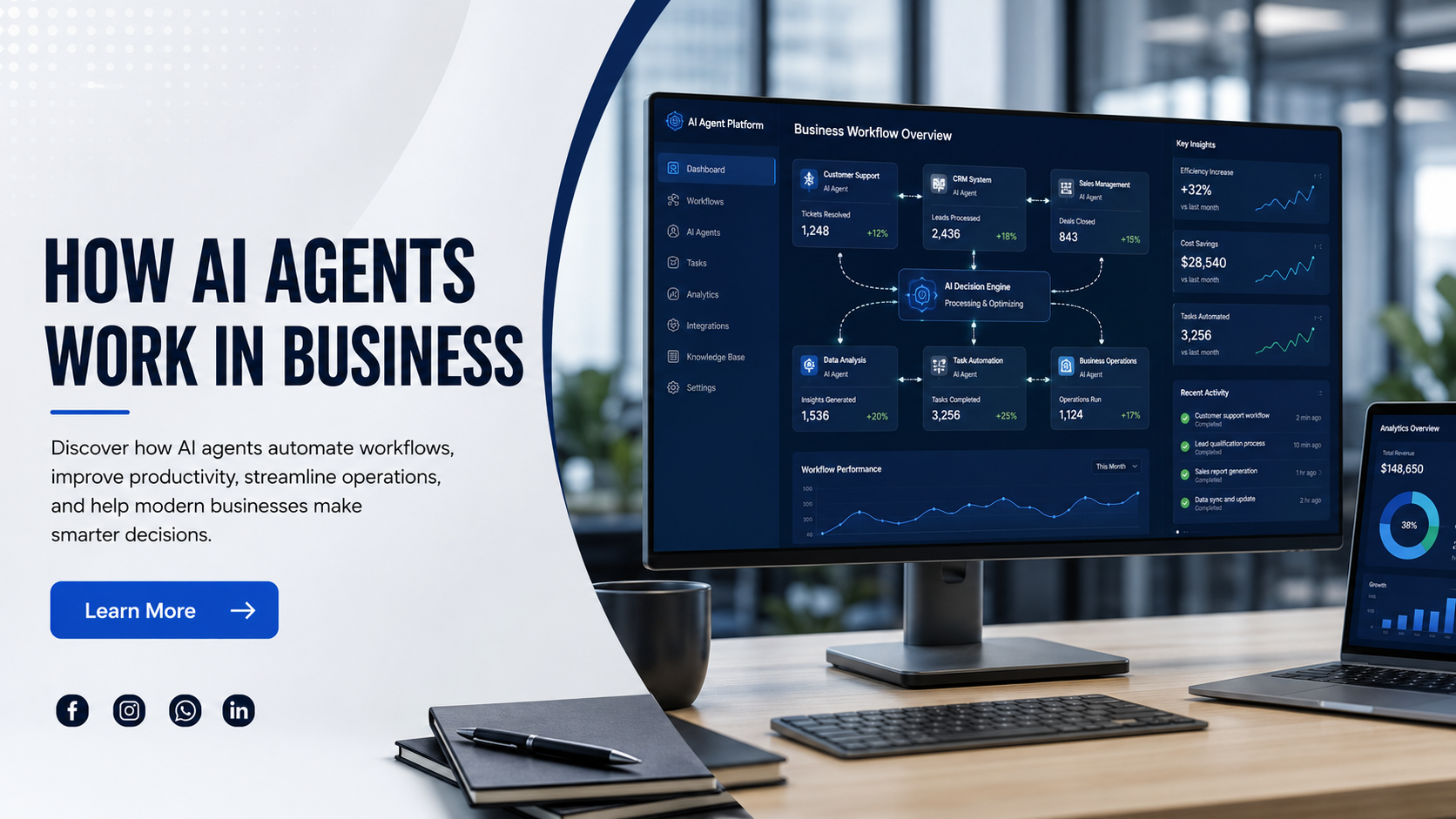
Artificial Intelligence has evolved far beyond simple chatbots and automated workflows. Today, businesses are increasingly adopting AI agents to handle tasks, make decisions, automate processes, and improve customer experiences at a scale that was difficult to imagine just a few years ago.
Whether you run a growing startup, a mid-sized company, or a large enterprise, chances are you have already encountered AI agents in some form. From customer support systems and sales automation tools to intelligent workflow management platforms, AI agents are becoming an important part of modern business operations.
But what exactly are AI agents? How do they work? And why are so many organizations investing in them?
In this guide, we’ll explore how AI agents work in real business environments, where they are being used, the benefits they offer, and what companies should consider before implementing them.
What Are AI Agents?
An AI agent is an intelligent software system that can understand goals, gather information, analyze situations, make decisions, and perform actions with minimal human intervention.
Unlike traditional software that follows predefined rules, AI agents are designed to adapt to changing situations and respond based on context. They can process information from multiple sources, understand user requests, and determine the most appropriate action to achieve a specific objective.
Think of an AI agent as a digital team member. Instead of simply providing information, it can actively complete tasks.
For example, when a customer asks about an order status, a traditional chatbot may simply display information from a database. An AI agent, however, can verify the order, check shipping updates, create a support ticket if needed, notify the customer, and even escalate the issue to a human representative when necessary.
This ability to understand, decide, and act is what makes AI agents different from conventional automation tools.

How AI Agents Actually Work
To understand the value of AI agents in business, it helps to look at how they operate behind the scenes.
Although different AI systems may vary in complexity, most AI agents follow a similar process.
Receiving a Goal oder Request
Every AI agent starts with a goal.
The goal may come from a customer, employee, manager, software application, or business workflow.
For example:
- A customer wants to track an order.
- A sales team wants to qualify new leads.
- An HR department wants to screen job applications.
- A finance team wants to identify unusual transactions.
The AI agent receives the request and begins determining how to achieve the desired outcome.
Gathering Information
Once the objective is identified, the AI agent collects relevant information from connected systems.
This may include:
- CRM software
- ERP platforms
- Internal databases
- Company documents
- Customer records
- Inventory systems
- Communication tools
The more integrated the AI agent is with business systems, the more effective it becomes.
Understanding Context
After gathering information, the AI agent analyzes the context.
Modern AI agents powered by large language models can understand natural language, identify intent, recognize patterns, and interpret complex requests.
For example, when a customer says:
“My order still hasn’t arrived and I need it urgently.”
The AI agent understands that the issue is not simply order tracking. The customer is expressing urgency and frustration, which may require a different response than a standard delivery inquiry.
Making Decisions
The next step involves decision-making.
Based on available information and predefined business rules, the AI agent determines the best action.
It may decide to:
- Respond directly
- Escalate the issue
- Update a database
- Schedule a meeting
- Generate a report
- Notify team members
This ability to evaluate multiple options and choose an appropriate response is one of the most powerful aspects of AI agents.
Taking Action
After making a decision, the AI agent performs the required task.
Depending on the use case, it may:
- Send emails
- Create support tickets
- Update CRM records
- Process requests
- Generate content
- Assign tasks
- Trigger automated workflows
The result is faster execution and reduced manual effort.
Also Read this: How AI is Transforming Businesses in India
AI Agents vs Traditional Business Automation
Many businesses already use automation tools, which raises an important question: how are AI agents different?
Traditional automation follows fixed rules.
For example:
“If a customer submits Form A, send Email B.”
While this works well for repetitive processes, it struggles when situations become more complex.
AI agents add intelligence to automation.
They can understand context, adapt to changing situations, analyze multiple variables, and make decisions without requiring every scenario to be manually programmed.
This flexibility allows businesses to automate processes that were previously considered too complex for traditional automation systems.
AI Agents vs Chatbots
One of the most common misconceptions is that AI agents and chatbots are the same thing.
While both can interact with users through conversation, their capabilities are significantly different.
A chatbot primarily answers questions.
An AI agent performs actions.
For example, if a customer asks about a delayed shipment, a chatbot might provide tracking information.
An AI agent can check shipping records, identify the cause of the delay, notify logistics teams, update the customer, create a support case, and recommend alternative solutions.
In simple terms, chatbots communicate, while AI agents communicate and act.
This distinction is becoming increasingly important as businesses look for ways to automate complete workflows rather than just conversations.

Real Business Examples of AI Agents
AI agents are already transforming industries across the world.
Customer Support
Customer support is one of the most popular applications for AI agents.
Instead of requiring human agents to handle every inquiry, AI systems can answer questions, troubleshoot issues, process requests, and escalate complex cases when necessary.
This reduces response times and improves customer satisfaction while lowering support costs.
Sales and Lead Management
Sales teams often spend significant time qualifying leads and managing follow-ups.
AI agents can analyze incoming leads, score prospects based on predefined criteria, schedule meetings, send follow-up emails, and update CRM systems automatically.
As a result, sales professionals can focus on building relationships and closing deals.
Marketing Automation
Marketing teams use AI agents to manage campaigns, analyze performance data, personalize customer experiences, and optimize content distribution.
Instead of manually reviewing reports, marketers can receive actionable recommendations generated by AI systems in real time.
Human Resources
Recruitment and employee onboarding involve many repetitive administrative tasks.
AI agents can screen resumes, answer candidate questions, schedule interviews, manage onboarding documentation, and assist employees with routine HR requests.
This improves efficiency while providing a better experience for both candidates and employees.
Operations Management
Businesses rely on numerous operational processes every day.
AI agents can monitor workflows, identify bottlenecks, predict potential issues, and recommend corrective actions before problems affect performance.
This proactive approach helps organizations operate more efficiently and reduce operational risks.
Also Read this: Best AI Tools for Business in 2026
Benefits of AI Agents for Businesses
The growing interest in AI agents is driven by their ability to deliver measurable business value.
One of the biggest benefits is improved productivity. Employees spend less time on repetitive administrative work and more time on strategic activities that contribute directly to business growth.
AI agents also help businesses provide faster customer service. Many routine inquiries can be resolved instantly without requiring human involvement.
Cost savings are another major advantage. Organizations can automate large portions of their operations without significantly increasing headcount.
AI agents also support better decision-making by analyzing large volumes of data and identifying insights that may be difficult for humans to detect quickly.
Perhaps most importantly, they allow businesses to scale operations more efficiently. As demand grows, AI agents can handle increasing workloads without the same limitations faced by human teams.
Challenges Businesses Should Consider
While AI agents offer significant benefits, successful implementation requires careful planning.
One common challenge is data quality. AI systems perform best when they have access to accurate, well-organized information.
Integration can also be complex, particularly when businesses rely on multiple software platforms that were not originally designed to work together.
Security and privacy considerations are equally important. Organizations must ensure that AI agents comply with data protection requirements and follow proper governance practices.
Human oversight remains essential as well. Although AI agents can automate many tasks, businesses should maintain appropriate review processes for critical decisions.
Understanding these challenges early can help companies achieve better outcomes from their AI initiatives.
How Businesses Can Successfully Implement AI Agents
Companies interested in adopting AI agents should begin by identifying repetitive, time-consuming processes that consume significant employee effort.
Rather than attempting to automate everything at once, it is often more effective to start with a specific use case that delivers clear business value.
Customer support, lead management, internal help desks, and workflow automation are common starting points.
Once a suitable use case is identified, businesses should focus on integrating the AI agent with existing systems and ensuring access to relevant data sources.
Testing is equally important. AI agents should be evaluated in real-world scenarios to ensure they deliver accurate and reliable outcomes.
As the system matures, businesses can expand AI capabilities into additional departments and workflows.
A phased approach often produces better results than large-scale deployments attempted all at once.
The Future of AI Agents in Business
The future of AI agents extends far beyond simple automation.
Organizations are already exploring multi-agent systems where multiple AI agents collaborate to complete complex business processes.
We are also seeing the rise of industry-specific AI agents designed for healthcare, finance, manufacturing, logistics, hospitality, retail, and professional services.
As AI technology continues to evolve, businesses will increasingly rely on intelligent systems to support decision-making, improve customer experiences, and streamline operations.
Rather than replacing employees entirely, AI agents are expected to become powerful digital assistants that help people work more efficiently and focus on higher-value activities.
Frequently Asked Questions (FAQs)
Q1. What is an AI agent in business?
An AI agent is an intelligent software system that can understand goals, gather information, make decisions, and perform tasks automatically. Businesses use AI agents to automate customer support, sales processes, workflow management, data analysis, and many other operational activities with minimal human intervention.
Q2. How do AI agents work in real businesses?
AI agents work by receiving a request or goal, collecting relevant information from connected systems, analyzing the context, making decisions, and taking appropriate actions. For example, an AI agent can handle customer inquiries, update CRM records, create support tickets, schedule meetings, and automate business workflows without requiring constant human involvement.
Q3. What is the difference between an AI agent and a chatbot?
A chatbot is mainly designed to answer questions and provide information through conversation. An AI agent goes beyond conversation by taking action. It can complete tasks, interact with business systems, automate workflows, make decisions, and help achieve specific business objectives.
Q4. What are some common examples of AI agents in business?
Common examples include customer support agents, sales assistants, marketing automation agents, HR onboarding assistants, inventory management agents, and workflow automation systems. These AI agents help businesses improve efficiency, reduce manual work, and provide faster services to customers and employees.
Q5. Can small businesses use AI agents?
Yes, AI agents are no longer limited to large enterprises. Small businesses can use AI agents for customer support, appointment scheduling, lead management, email automation, social media management, and routine administrative tasks. This helps small teams save time and improve productivity without increasing operational costs.
Q6. What are the main benefits of AI agents for businesses?
AI agents help businesses automate repetitive tasks, improve customer experiences, increase productivity, reduce operational costs, provide faster response times, and support better decision-making. They also allow organizations to scale operations more efficiently while maintaining service quality.
Q7. Are AI agents secure for business use?
AI agents can be secure when implemented correctly with proper security measures, access controls, data encryption, and compliance practices. Businesses should ensure that AI systems are integrated with trusted platforms and follow data privacy regulations to protect sensitive information.
Q8. Will AI agents replace human employees?
AI agents are more likely to assist employees rather than replace them completely. They are best suited for handling repetitive and time-consuming tasks, allowing employees to focus on strategic work, problem-solving, customer relationships, and business growth activities that require human judgment and creativity.

Final Thoughts
AI agents are rapidly becoming an important part of modern business operations. Unlike traditional automation tools, they can understand context, make decisions, and take action to achieve specific goals.
From customer support and sales automation to HR management and operational workflows, AI agents are helping businesses improve efficiency, reduce costs, and deliver better customer experiences.
Companies that begin exploring AI agent technology today will be better positioned to adapt to the next generation of business automation. By starting with practical use cases and focusing on measurable outcomes, organizations can unlock significant value while preparing for a future where intelligent automation plays an increasingly central role in business success.


