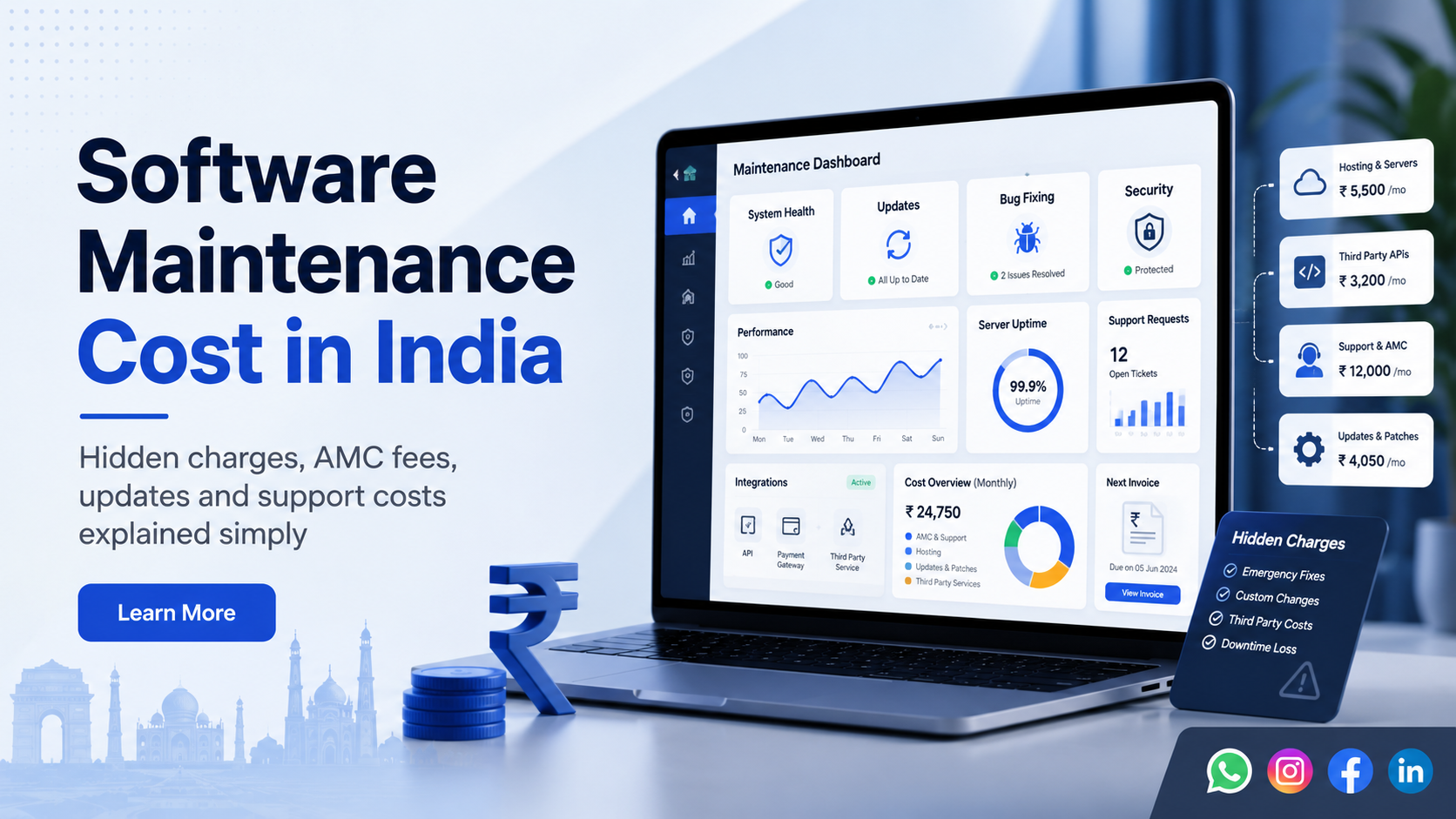
Many businesses plan their software development budget carefully, but they often forget one important part: software maintenance cost after launch.
Once your software, web application, mobile app, CRM, ERP, ecommerce platform, or business dashboard goes live, it does not stop needing attention. It may need bug fixing, updates, server support, security checks, backup management, performance improvement, API monitoring, and small changes based on real user feedback.
This is where software maintenance becomes important.
The software maintenance cost in India depends on many factors such as software complexity, number of users, hosting setup, third-party integrations, security needs, support hours, and the type of maintenance contract you choose. The problem is that many businesses do not understand these costs clearly at the beginning. Later, they feel surprised when extra charges appear.
In this blog, we will explain software maintenance charges in India, hidden costs, AMC pricing, what is usually included, what may be excluded, and how you can avoid unexpected expenses.
What Is Software Maintenance?
Software maintenance means keeping your software stable, updated, secure, and useful after it is launched.
Many people think software maintenance only means fixing bugs. That is not completely true. Bug fixing is just one part of maintenance. A proper software maintenance plan may also include performance checks, security updates, database backup, server monitoring, compatibility updates, minor improvements, API checks, and technical support.
For example, if your software is connected with a payment gateway, SMS API, WhatsApp API, email service, cloud server, or mobile app, all these parts may need regular monitoring. If one third-party service changes its policy or API version, your software may also need an update.
Software is not a one-time product that you build and forget. It is more like a business system that needs regular care. Without maintenance, even a well-developed application can become slow, outdated, insecure, or difficult to use over time.
Average Software Maintenance Cost in India
There is no single fixed price for software maintenance in India because every software is different. A small business website, a custom CRM, a mobile app, an ERP system, and a large enterprise platform will not have the same maintenance cost.
In general, software maintenance charges in India are usually calculated in three ways: monthly support, hourly support, or annual maintenance contract, also called AMC.
For small applications or basic business software, monthly maintenance can be lower if the system has limited users and fewer features. For custom software with multiple modules, admin panels, reports, user roles, payment integration, and third-party APIs, the cost will be higher. For enterprise software, the cost may increase further because it may require faster response time, security monitoring, database optimization, and dedicated technical support.
Many businesses also calculate annual software maintenance cost as a percentage of the original development cost. This percentage can vary based on the software type, technology, support scope, and service-level expectations.
So, instead of asking only, “What is the software maintenance cost in India?”, a better question is:
“What exactly is included in the maintenance plan, and what will be charged separately?”
That question will give you much better clarity.
Software AMC Cost in India: How It Usually Works
AMC stands for Annual Maintenance Contract. In simple words, it is a yearly support agreement between the software company and the client.
A software AMC usually covers regular support and maintenance for a defined period. It may include bug fixing, minor updates, technical assistance, server checks, backup support, performance monitoring, and small changes depending on the agreement.
However, every AMC is different. Some companies include only bug fixing. Some include limited support hours. Some include server monitoring, basic security updates, and monthly reports. Some may charge separately for everything outside the agreed scope.
This is why software AMC cost in India should never be judged only by the price. A cheaper AMC may look attractive at first, but if important services are excluded, you may end up paying more later.
Before signing any software maintenance contract, always check:
What is included?
What is excluded?
How many support hours are covered?
What is the response time?
Are server, hosting, and third-party tools included?
Are new features included or charged separately?
A clear AMC agreement helps both sides avoid confusion.

Factors That Affect Software Maintenance Charges in India
Software maintenance cost changes from project to project because every application has different requirements. Here are the main factors that affect software support cost in India.
Software Size and Complexity
A simple admin panel or basic website will cost less to maintain than a complete ERP, CRM, ecommerce system, booking portal, logistics dashboard, or SaaS platform. More features mean more testing, more updates, and more chances of technical issues.
Number of Users
If only a few people use the software, support may be simple. But if hundreds or thousands of users depend on it daily, maintenance becomes more important. More users can create more support requests, performance issues, access problems, and data handling needs.
Technology Stack
The technology used to build the software also affects maintenance cost. Some technologies are easier to maintain, while older or poorly documented technologies may need more effort. If the software is built on outdated frameworks, maintenance can become more expensive over time.
Third-Party Integrations
Many modern applications depend on payment gateways, SMS APIs, WhatsApp APIs, Google Maps, email tools, CRM systems, accounting software, shipping APIs, or cloud services. If any third-party integration changes, breaks, or requires an upgrade, your software may need technical work.
Hosting and Server Setup
Software hosted on a shared server, VPS, dedicated server, or cloud platform will have different maintenance needs. Cloud servers may require monitoring, backup, scaling, security configuration, and performance checks.
Security Requirements
If your software stores customer data, payment details, employee records, healthcare data, financial information, or business-sensitive data, security maintenance becomes very important. Security patches, access control, backups, audit logs, and monitoring may increase the cost but also protect your business.
Support Response Time
If you need immediate support, emergency fixes, or priority response, the cost will usually be higher. A business-critical application needs faster support than a software tool used only occasionally.
Hidden Charges in Software Maintenance Most Businesses Miss
Hidden charges are one of the biggest concerns for businesses after software development. Many hidden costs are not actually unfair, but they become a problem when they are not explained clearly in the beginning.
Here are the most common hidden charges in software maintenance.
1. Server and Hosting Renewal Charges
Your software needs a place to run. This may be a cloud server, VPS, dedicated server, shared hosting, or managed hosting environment.
Many businesses assume hosting is included in maintenance, but that is not always true. Hosting renewal, server upgrade, storage increase, bandwidth usage, database server, CDN, and cloud services may be charged separately.
If your application grows and receives more traffic or users, your server cost may also increase.
2. Domain, SSL, and Security Renewal Charges
If your software runs on a website or web application, you may need domain renewal and SSL certificate renewal. SSL is important because it helps secure data transfer between the user and the application.
Some SSL certificates are free, while others are paid depending on the security level and business requirement. Security tools, malware protection, firewall setup, and vulnerability checks may also come at an additional cost.
3. Third-Party API and Plugin Charges
Many software systems use third-party services. These may include SMS, WhatsApp, email, payment gateway, maps, video calls, shipping, analytics, CRM, accounting tools, or notification services.
Some of these services are free up to a limited usage. After that, they become paid. In some cases, the third-party provider may change pricing or update their API, and your software will need changes to keep working properly.
This is one of the most common hidden costs after software development.
4. Major Version Upgrade Charges
Small updates may be part of maintenance, but major upgrades are usually different.
For example, if your software framework, programming language, mobile operating system, database version, or server environment becomes outdated, it may need a major upgrade. This takes more time, testing, and development effort.
A major version upgrade is not the same as regular maintenance. It is usually charged separately because it may involve technical restructuring.
5. Emergency Support Charges
If your software suddenly stops working during business hours, it needs urgent attention. But if you need support outside normal working hours, on weekends, or during holidays, the software company may charge emergency support fees.
This should be clearly mentioned in the support agreement. If your software is business-critical, you should discuss emergency support before signing the maintenance contract.
6. New Feature Development Charges
This is where many businesses get confused.
Maintenance usually means keeping the existing software stable and updated. It does not always include building new modules, new dashboards, new mobile app screens, new reports, new integrations, or completely new workflows.
For example, if you already have a CRM and now want to add a customer loyalty module, that will usually be treated as new feature development, not normal maintenance.
7. Data Backup and Recovery Charges
Backups are very important, but not every maintenance plan includes advanced backup and recovery.
Basic backup may be included in some plans. But automated backup, cloud backup storage, disaster recovery, database restoration, and backup monitoring may be charged separately depending on the setup.
If your business depends heavily on data, you should never ignore backup and recovery planning.
8. Bug Fixing Beyond Scope
Bug fixing is usually part of maintenance, but the scope matters.
If the bug is related to the original software, it may be included. But if the issue happens because of a third-party service change, server misconfiguration, unauthorized code change, outdated plugin, or new feature request, it may be charged separately.
This is why the maintenance agreement should clearly define what type of bugs are covered.

What Should Be Included in a Good Software Maintenance Plan?
A good software maintenance plan should be clear, practical, and transparent. It should tell you exactly what support you will receive and what will cost extra.
A well-structured plan may include bug fixing, minor updates, security patches, server monitoring, database backup, performance checks, compatibility support, API monitoring, and basic technical assistance.
It should also define the support response time. For example, critical issues may need faster attention, while minor changes can be handled within a normal support timeline.
A good maintenance plan should also include a clear change request process. This means if you ask for a new feature or major change, the software company should explain the cost, timeline, and technical impact before starting the work.
For business owners, the most important thing is not just the price. The real value is clarity. When everything is documented properly, you know what you are paying for and what to expect.
Software Maintenance Cost by Type of Software
Different types of software need different levels of maintenance. That is why the cost can vary.
Website Maintenance Cost
A business website may need content updates, CMS updates, plugin updates, security checks, speed optimization, backup, and minor design changes. Website maintenance is usually simpler than custom software maintenance, unless the website has advanced features, ecommerce, custom forms, or user dashboards.
Mobile App Maintenance Cost
Mobile app maintenance cost in India depends on whether the app is built for Android, iOS, or both. Apps need regular updates because Android and iOS keep changing their operating system versions, policies, and device compatibility requirements.
Mobile app maintenance may include bug fixing, API updates, app store policy changes, performance improvement, push notification checks, and security updates.
Web Application Maintenance Cost
A web application such as CRM, ERP, booking system, admin dashboard, SaaS platform, or internal portal usually needs more structured maintenance. It may include database optimization, user access control, server monitoring, reports, integrations, bug fixing, and feature improvements.
Web application maintenance cost depends on complexity, number of users, modules, and daily usage.
Ecommerce Software Maintenance Cost
Ecommerce software needs regular maintenance because it directly affects sales. If payment, checkout, inventory, coupons, shipping, order tracking, or customer login stops working, the business can lose revenue.
Ecommerce maintenance may include payment gateway support, security updates, product database management, order flow checks, performance optimization, and third-party integration monitoring.
ERP or CRM Maintenance Cost
ERP and CRM systems are usually more complex because they handle important business operations. They may include sales, finance, HR, inventory, purchase, approvals, reports, customer data, and team workflows.
ERP software maintenance cost in India is usually higher than basic website maintenance because these systems need reliability, data accuracy, user roles, access control, and regular support.
Monthly Support vs Annual Maintenance Contract: Which Is Better?
Both monthly support and annual maintenance contracts can be useful, depending on your business needs.
Monthly support is suitable when your software needs regular but limited assistance. It gives flexibility and works well for small businesses or growing companies that do not want to commit to a large yearly contract.
Annual Maintenance Contract is better when your software is important for daily business operations. AMC gives more predictable cost, structured support, and better planning for updates and maintenance.
Hourly support is also an option for small tasks or one-time issues. But if your software needs frequent support, hourly billing can become expensive and unpredictable.
If your application is business-critical, AMC is usually a better choice. If your software is small and rarely needs changes, monthly or hourly support may be enough.
How to Reduce Software Maintenance Cost Without Compromising Quality
Software maintenance cost can be controlled if you plan properly from the beginning.
The first step is to build software with clean and scalable code. Poorly developed software may look cheaper at the start, but it becomes expensive to maintain later.
Proper documentation is also important. If your software has clear technical documentation, database structure, API details, and deployment process, any developer can understand it faster. This reduces future support time.
Avoid adding unnecessary features in the first version. More features mean more maintenance. Build what is useful, test it properly, and improve step by step.
Use reliable hosting. Cheap or poor-quality hosting can create speed issues, downtime, security problems, and frequent support requests.
Keep third-party tools limited and necessary. Too many plugins or APIs can increase dependency and future maintenance cost.
Regular updates also help. If you ignore updates for a long time, the software may need a major upgrade later, which can cost more.
Most importantly, define the maintenance scope clearly. When the agreement is transparent, you can avoid confusion and hidden charges.
Questions to Ask Before Signing a Software Maintenance Contract
Before signing a software maintenance contract, ask practical questions. This will help you understand the real cost and avoid surprises later.
Here are some important questions to ask:
What is included in the maintenance plan?
What is excluded from the AMC?
How many support hours are included?
What is the response time for urgent issues?
Are server and hosting charges included?
Are domain, SSL, and security renewals included?
Are third-party API charges included?
Are backups included?
Are new features charged separately?
How will emergency support be billed?
Will I receive monthly maintenance reports?
Who owns the source code and documentation?
Can another company maintain the software in the future?
These questions may look simple, but they can save a business from major confusion later.
A professional software company will always be comfortable explaining these points clearly.
Can Another Company Maintain My Existing Software?
Yes, another software company can maintain your existing software, but only if the required access and documentation are available.
The new company may need source code access, database access, hosting or server access, admin panel access, API details, third-party service credentials, and technical documentation.
If the old software is poorly coded or has no documentation, the new team may need extra time to study the system. This process is usually called code review or technical audit.
After reviewing the software, the maintenance team can explain what is stable, what needs improvement, what risks exist, and what support plan is suitable.
So, if you are planning to shift from one software vendor to another, make sure you have proper access and ownership of your software files, code, database, and documentation.
Why Choosing the Right Software Maintenance Company Matters
Software maintenance is not just technical support. It directly affects business continuity, customer experience, data security, and team productivity.
The right software maintenance company should understand your business process, not just your code. They should know how your users work, what features are important, which modules are business-critical, and where technical risks may appear.
A good maintenance team will not only fix issues after they happen. They will also monitor performance, suggest improvements, update security, check integrations, and help your software stay useful for the long term.
If your business needs reliable long-term support, choosing experienced software maintenance services in India can help you manage bug fixes, updates, security, hosting support, and software performance with better clarity.
For businesses in Mumbai and across India, working with a professional team like Aimbeat can help bring structure, transparency, and long-term reliability to software support and maintenance.

Final Thoughts
Software maintenance cost in India depends on many factors, including software size, complexity, users, hosting, security, integrations, support hours, and AMC scope.
The real problem is not always the cost itself. The problem starts when businesses do not understand what is included and what is excluded.
Before choosing any maintenance plan, ask clear questions about bug fixing, hosting, server support, backups, API charges, emergency support, security updates, and new feature development.
A well-maintained software system can save time, reduce downtime, improve performance, protect data, and support business growth. Instead of treating maintenance as an extra expense, businesses should see it as an important part of long-term software success.
FAQs on Software Maintenance Cost in India
1. How much does software maintenance cost in India?
Software maintenance cost in India depends on software complexity, number of users, features, integrations, hosting setup, support hours, and security requirements. A small application may need basic monthly support, while a large ERP, CRM, ecommerce platform, or enterprise software may need a structured AMC plan.
2. What is included in software maintenance?
Software maintenance may include bug fixing, minor updates, security patches, server monitoring, database backup, performance checks, compatibility support, API monitoring, and technical assistance. The exact inclusions depend on the maintenance agreement.
3. Is software AMC compulsory?
Software AMC is not always compulsory, but it is highly recommended for business-critical software. If your software is used daily for sales, operations, customers, employees, orders, or billing, regular maintenance can help avoid downtime and technical issues.
4. Are new features included in software maintenance?
Usually, new features are not included in standard software maintenance. Maintenance mainly covers existing software stability, bug fixing, updates, and support. Major new modules, dashboards, integrations, or workflows are generally charged separately.
5. What are the hidden charges in software maintenance?
Common hidden charges include hosting renewal, server upgrade, SSL renewal, domain renewal, third-party API charges, plugin fees, emergency support, major version upgrades, backup storage, and new feature development.
6. Can another company maintain my existing software?
Yes, another company can maintain your existing software if you have source code access, database access, hosting access, admin credentials, API details, and proper documentation. If documentation is missing, the new team may need to perform a technical audit first.
7. How can I reduce software maintenance cost?
You can reduce software maintenance cost by using clean code, proper documentation, reliable hosting, regular updates, limited third-party dependencies, clear AMC terms, and proper testing before every release.