
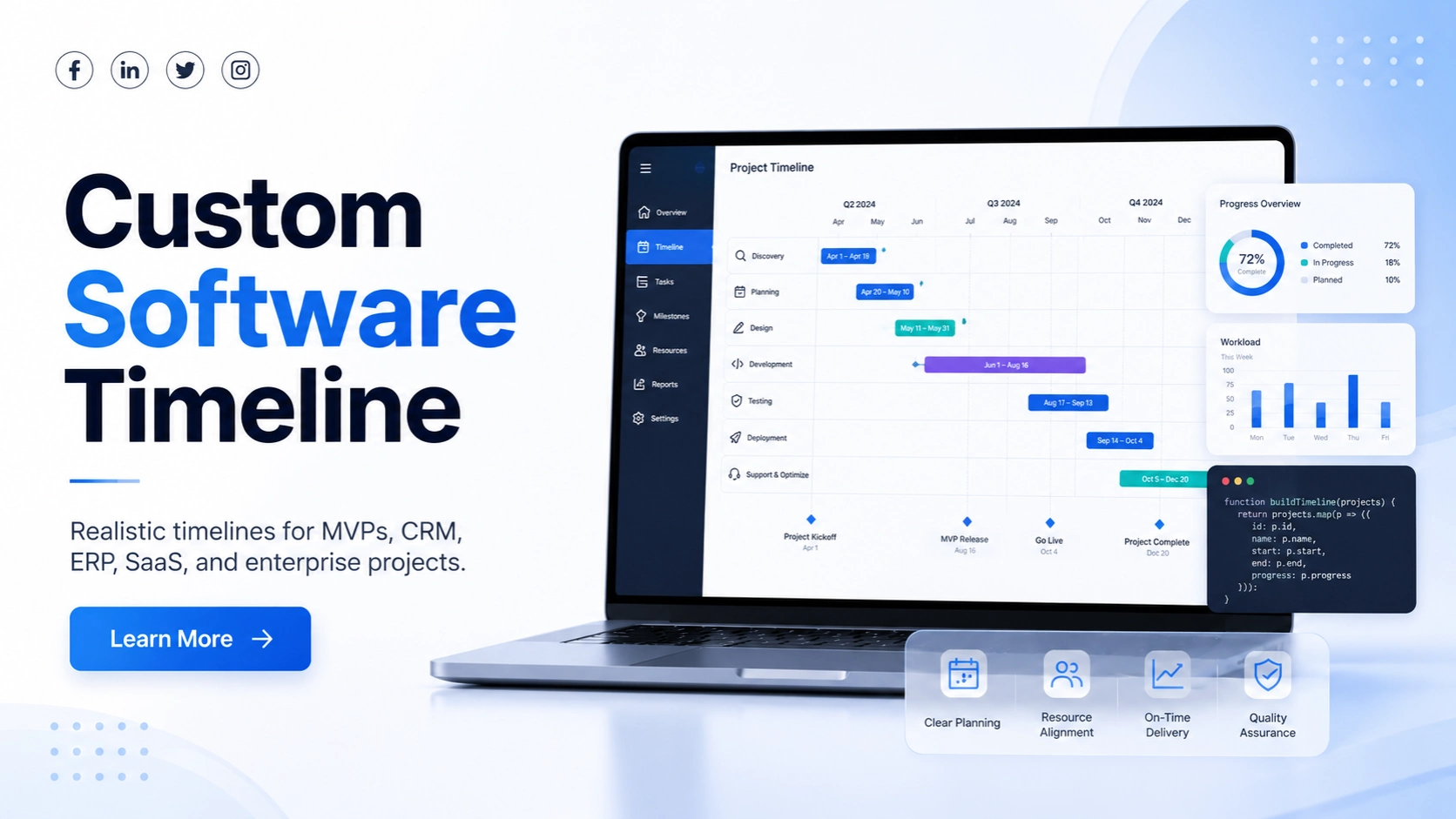
How long does custom software development take? For most business software projects, a realistic development timeline is around 3 to 12 months. A focused MVP may be ready in 2 to 4 months, while a complex ERP, SaaS platform, or enterprise application can require 8 to 18 months or more.
The actual timeline depends less on the name of the software and more on what needs to be built inside it. User roles, workflows, integrations, data migration, security requirements, reports, automation, testing, and approval cycles can all change the delivery date.
If you are planning a software project, the timelines below give you a practical starting point.
Custom Software Development Timeline at a Glance
Here is a quick comparison of typical development timelines by project type.
| Project Type | Typical Development Timeline |
| Prototype / Proof of Concept | 3–6 weeks |
| MVP | 2–4 months |
| Internal Business Application | 3–6 months |
| Custom CRM Software | 4–7 months |
| Web Application | 3–8 months |
| Mobile Application | 3–7 months |
| SaaS Platform | 5–10 months |
| Marketplace Platform | 5–10 months |
| Custom ERP Software | 6–12+ months |
| Enterprise Software | 8–18+ months |
These are planning ranges rather than fixed delivery promises.
A basic CRM and an enterprise CRM may both be called “CRM software,” but their development timelines can be completely different.
A CRM with lead management, customer profiles, tasks, and simple reporting may take a few months. Add WhatsApp automation, ERP integration, complex permissions, data migration, approval workflows, AI features, and advanced analytics, and the same project can take considerably longer.

Custom Software Development Timeline by Project Complexity
A useful software development timeline should also consider complexity.
Simple Custom Software: Around 2-4 Months
A relatively simple project usually has:
- One main business process
- Limited user roles
- Basic admin controls
- Standard dashboards
- Few external integrations
- Simple reports
- Limited automation
For example, a business may need an internal lead-management system where employees can add leads, update their status, schedule follow-ups, and generate basic reports.
A focused project like this can often be completed within 8 to 16 weeks when requirements are clear and feedback is provided quickly.
Medium Complexity Software: Around 4-8 Months
Medium-complexity projects normally involve several connected workflows.
Typical requirements include:
- Multiple user roles
- Custom dashboards
- Different departments
- API integrations
- Automated notifications
- Approval workflows
- Advanced reports
- Role-based permissions
- Mobile-responsive interfaces
- Moderate data migration
Consider a custom CRM used by sales, support, management, and operations teams.
The system may need lead pipelines, automated follow-ups, WhatsApp or email integration, user permissions, reports, dashboards, and customer history.
A project with this level of complexity may require around 4 to 8 months.
Complex or Enterprise Software: Around 8-18+ Months
Large software projects usually involve multiple systems, departments, integrations, and security requirements.
They may include:
- Multiple interconnected modules
- Complex business rules
- Large numbers of users
- Web and mobile applications
- Legacy software integration
- Data migration
- Advanced reporting
- Custom APIs
- Audit logs
- Security controls
- Compliance requirements
- High availability
- Scalable infrastructure
- Multiple approval levels
For example, an enterprise ERP connecting finance, inventory, procurement, sales, HR, CRM, and management reporting may take 8 to 18 months or longer.
The final duration depends on whether everything is being launched together or delivered in phases.
How Long Does Each Software Development Stage Take?
A complete custom software development timeline is usually divided across several stages.
1. Discovery and Requirements: 1-3 Weeks
This is where the business requirements are converted into a clear development scope.
The team identifies:
- Business problems
- Required features
- User roles
- Workflows
- Integrations
- Reports
- Security needs
- Technical dependencies
Skipping proper discovery may save a week initially but can create months of rework later.
Clear requirements are one of the biggest factors in making a development estimate reliable.
2. UX and Wireframing: 1-3 Weeks
Wireframes show how users will move through the software before visual design and development begin.
This phase may include:
- Login flows
- Dashboards
- Forms
- Navigation
- User journeys
- Administrative screens
- Workflow screens
Simple software may require only a few wireframes, while a large enterprise system may need dozens.
3. UI Design: 2-4 Weeks
The UI design phase turns approved wireframes into the final interface.
The design team usually defines:
- Layout
- Typography
- Buttons
- Forms
- Tables
- Dashboards
- Responsive views
- Design components
Design does not always need to finish completely before development begins. In an Agile project, development can start on approved screens while other screens are still being designed.
4. Technical Architecture: 1-2 Weeks
The development team decides how the software should be structured.
This may include:
- Backend architecture
- Database structure
- API architecture
- Cloud infrastructure
- Authentication
- User permissions
- Integration strategy
- Security requirements
Architecture becomes especially important for SaaS and enterprise applications because decisions made here directly affect future scalability.
5. Core Development: 6-24+ Weeks
Development normally takes the largest share of the project timeline.
Frontend developers build the interface users interact with, while backend developers handle business logic, databases, APIs, permissions, and system integrations.
Development time increases when the project includes:
- Complex business rules
- Many user roles
- Multiple modules
- Large dashboards
- Workflow automation
- Real-time functionality
- Third-party integrations
- Advanced search
- AI features
- Complex reporting
A simple business application may require a few development sprints. A multi-module enterprise platform may need many months.
6. Integrations: 2-8+ Weeks
Integrations often create more uncertainty than expected.
Common integrations include:
- Payment gateways
- CRM systems
- ERP software
- Accounting platforms
- Logistics providers
- Google services
- Email platforms
- SMS gateways
- Authentication systems
- External APIs
A well-documented API may take only a short time to integrate.
An outdated or poorly documented third-party system may require significantly more development and testing.
7. QA and Software Testing: 2-6 Weeks
Testing should not be treated as something that happens only before launch.
QA usually runs throughout development.
Testing may cover:
- Functional testing
- Integration testing
- Responsive testing
- Browser testing
- User permissions
- Security checks
- Performance
- Error handling
- Regression testing
Complex business software requires more testing because changing one module can sometimes affect another.
8. User Acceptance Testing: 1-3 Weeks
User Acceptance Testing, or UAT, is when the client’s team verifies that the software works correctly in real business scenarios.
For example:
A CRM may technically allow a lead to move from one stage to another, but the actual sales team needs to confirm that the workflow matches how they operate.
Quick and structured UAT feedback can prevent unnecessary delays close to launch.
9. Deployment: A Few Days to 2 Weeks
Deployment may include:
- Production server setup
- Database configuration
- Domain configuration
- SSL
- Cloud infrastructure
- Final migration
- Monitoring
- Backups
- Production testing
Simple applications may go live quickly.
Enterprise systems sometimes require phased deployment because launching every department simultaneously can introduce unnecessary operational risk.

Which Stage Usually Takes the Longest?
For most projects, development and integration require the most time.
Writing code is only one part of the work.
Developers must also connect modules, validate business rules, handle edge cases, test APIs, manage user permissions, and ensure different parts of the software work together.
Integration can become especially time-consuming when the software depends on systems controlled by another provider.
That is why two applications with a similar number of screens can still have completely different development timelines.
How Long Does an MVP Take to Develop?
A typical MVP development timeline is around 2 to 4 months.
The important word here is minimum.
An MVP should contain the smallest set of features required to solve the main user problem and validate the product.
For example, a marketplace MVP may initially include:
- User registration
- Buyer accounts
- Seller accounts
- Product listings
- Search
- Checkout
- Payments
- Basic admin panel
Features such as loyalty programs, advanced recommendations, complex analytics, multiple payment systems, AI functionality, and advanced seller tools can be added later.
Trying to include the complete product roadmap inside the MVP is one of the easiest ways to turn a 3-month project into a 6-month project.
How Long Does Custom CRM Development Take?
A custom CRM development timeline typically starts around 4-7 months for a moderately complex system.
A focused CRM may include:
- Lead management
- Customer records
- Pipeline stages
- Tasks
- Follow-ups
- User permissions
- Dashboard
- Reports
More advanced CRM systems may also include:
- WhatsApp automation
- Email automation
- ERP integration
- Accounting integration
- Sales forecasting
- Advanced workflows
- Multi-branch management
- AI recommendations
- Custom reporting
Those additional requirements can push development beyond the typical range.
How Long Does Custom ERP Development Take?
A custom ERP commonly requires 6-12 months or more.
ERP development takes longer because different departments need to work within the same connected system.
A typical ERP may include:
- Inventory
- Sales
- Purchase
- Finance
- HR
- Procurement
- Production
- CRM
- Reporting
- Management dashboards
Data migration can also be a major part of an ERP project.
Migrating thousands of clean records is relatively straightforward. Migrating years of inconsistent spreadsheets and legacy-system data is a very different task.
Large ERP projects are therefore often delivered module by module.
How Long Does Enterprise Software Development Take?
An enterprise software development timeline can range from around 8 months to 18 months or more.
Enterprise applications often need much more than feature development.
Additional requirements may include:
- Single sign-on
- Role-based access
- Audit trails
- Compliance
- Data encryption
- Disaster recovery
- Scalability
- Legacy integration
- Large data migration
- Multiple departments
- Multi-location operations
- High availability
For enterprise projects, phased delivery is often more practical than waiting for every planned module to be completed before launch.
What Can Add Weeks or Months to a Software Project?
Several factors can significantly change the original software development timeline.
Scope Changes
Adding new features after development begins affects more than the feature itself.
A new module may require changes to:
- Database structure
- APIs
- Permissions
- Interface
- Testing
- Reports
This is why uncontrolled scope creep can create major delays.
Third-Party Integrations
External APIs are not always predictable.
Documentation may be incomplete, access may require approval, or another platform may have technical limitations.
Important integrations should therefore be identified during discovery rather than halfway through development.
Data Migration
Data migration is frequently underestimated.
The main challenge is usually not transferring the data. It is cleaning, mapping, validating, and restructuring it before migration.
Businesses replacing old software should evaluate their current data early.
Complex User Permissions
A system with two user types is very different from one with:
- Super Admin
- Branch Admin
- Department Head
- Manager
- Employee
- Vendor
- Customer
Each user may have different access to screens, actions, reports, and data.
More permissions mean more development and more testing.
Security and Compliance
Fintech, healthcare, financial, and enterprise applications often require additional security controls.
Those requirements need to be considered during architecture rather than added just before launch.
Slow Feedback
Development may stop even when the technical team is ready to continue.
Waiting for approvals on:
- Requirements
- Designs
- Integrations
- Business rules
- UAT feedback
can add days or weeks to the project.
Having one responsible decision-maker on the client side can significantly improve delivery speed.
Does Adding More Developers Make Software Development Faster?
Sometimes but not in a straight line.
If a project requires six months with three developers, adding another three developers does not automatically reduce the timeline to three months.
Some tasks must happen in sequence.
One developer may need an API before another developer can complete a related feature. Developers also need to review, merge, and test each other’s work.
A larger team is most useful when the application can be divided into independent workstreams such as:
- Web frontend
- Mobile app
- Backend APIs
- Integrations
- Admin panel
- QA
The right team structure matters more than simply adding people.
Can Custom Software Be Built in 3 Months?
Yes, some custom software can realistically be developed in around three months.
A 3-month timeline is more achievable for:
- MVPs
- Internal tools
- Basic CRMs
- Booking applications
- Customer portals
- Focused workflow systems
It becomes much less realistic for:
- Full ERP systems
- Large SaaS platforms
- Complex marketplaces
- Multi-department enterprise software
- Applications requiring major legacy integrations
The best approach is often to reduce the first-release scope, not the quality.
MVP vs Full Product: A More Practical Development Approach
Instead of building everything before launch, a business can divide development into phases.
Phase 1: MVP – Around 10-14 Weeks
Launch the essential functionality needed to solve the main problem.
Phase 2: Business Features – Additional 6-10 Weeks
Add automation, reporting, integrations, advanced permissions, and supporting workflows.
Phase 3: Scale and Optimization – Ongoing
Add advanced analytics, AI features, integrations, new modules, and performance improvements based on real usage.
This approach gives businesses working software earlier and reduces the risk of investing months into features users may not actually need.
Example: Realistic Timeline for a Custom CRM
Suppose a business wants a CRM with:
- Leads
- Contacts
- Sales pipeline
- Follow-ups
- Dashboards
- Reports
- User permissions
- Email integration
- WhatsApp integration
A realistic project schedule could look like this:
| Weeks 1-2 |
Requirements, workflows, user roles, and project planning.
|
| Weeks 3-5 |
Wireframes and interface design.
|
| Weeks 4-6 |
Database and architecture planning.
|
| Weeks 6-16 |
Frontend and backend development.
|
| Weeks 10-16 | External integrations. |
| Weeks 14-18 | Testing and bug fixing. |
| Weeks 18-20 |
UAT, deployment, and launch.
|
Estimated total: around 4–5 months.
Adding ERP integration, complex data migration, multiple business units, AI functionality, or advanced workflow automation would increase this timeline.

How to Reduce Software Development Time Without Reducing Quality
Faster development should come from better planning, not cutting testing.
A few practical ways to shorten the software development timeline are:
- Finalize Phase 1 requirements before development starts
- Separate must-have features from future features
- Start with an MVP when appropriate
- Assign one clear decision-maker
- Provide integration documentation early
- Prepare migration data in advance
- Review designs quickly
- Give structured UAT feedback
- Use proven frameworks and reusable components where appropriate
- Automate testing and deployment
- Avoid unnecessary changes during active development
One of the biggest improvements is simply deciding what does not need to be in Version 1.
Questions to Ask Before Accepting a Software Development Timeline
When a software company gives you a timeline, don’t only ask how many months the project will take.
Ask:
- What features are included in the estimate?
- Is discovery included?
- Does the timeline include UX/UI design?
- Are third-party integrations included?
- Does the estimate include data migration?
- Is QA and testing included?
- Is User Acceptance Testing included?
- Which dependencies could affect delivery?
- What happens if requirements change?
- Is deployment included?
A shorter estimate is not automatically a better estimate.
A reliable timeline should clearly explain what is included, what assumptions have been made, and what could change the delivery date.
Get a Realistic Custom Software Development Timeline
Generic estimates are useful for early planning, but your actual timeline depends on your requirements.
Aimbeat develops custom software, CRM, ERP, web applications, mobile applications, SaaS products, and enterprise software based on real business workflows.
Instead of forcing every requirement into one large release, our team can help you define the right project scope, identify technical dependencies, prioritize essential features, and plan development in practical phases.
If you already have a software idea or requirement document, share it with Aimbeat to discuss the expected scope, development approach, and a realistic project timeline.
Get a Free Software Consultation with Aimbeat.
Frequently Asked Questions
How long does custom software development usually take?
Most custom software development projects take around 3 to 12 months. A focused MVP may take 2 to 4 months, while complex enterprise platforms can require 8 to 18 months or more.
How long does an MVP take to build?
A focused MVP generally takes around 2 to 4 months, depending on the number of core features, integrations, platforms, and testing requirements.
Can custom software be developed in 3 months?
Yes. A clearly defined MVP, internal business tool, booking platform, basic CRM, or focused workflow application may be achievable in around three months. Large ERP and enterprise projects generally require longer.
How long does custom CRM development take?
A moderately complex custom CRM may take around 4 to 7 months. Integrations, advanced automation, data migration, and complex reporting can increase the timeline.
How long does custom ERP development take?
A custom ERP can take around 6 to 12 months or more, especially when multiple departments, legacy systems, large data migration, and complex workflows are involved.
How long does enterprise software development take?
Complex enterprise software commonly requires 8 to 18 months or more because of integrations, security, compliance, scalability, migration, and multi-department requirements.
What causes software development delays?
Common causes include unclear requirements, scope changes, delayed feedback, third-party API issues, complex integrations, poor data quality, security requirements, and unexpected technical dependencies.
Does a larger development team reduce the timeline?
A larger team can help when work can be split across independent modules, but doubling the number of developers does not automatically cut the development timeline in half.
How accurate is a software development timeline before discovery?
An early timeline should be treated as a planning range. A more reliable estimate becomes possible after the project scope, workflows, integrations, data requirements, platforms, and technical dependencies have been reviewed.
Final Takeaway
So, how long does custom software development take?
A focused project may take a few months. A medium-complexity business application may take 4-8 months, while ERP and enterprise software can require 8-18 months or longer.
The most useful timeline is not the shortest number a development company can give you. It is the timeline built around a clearly defined scope, realistic technical dependencies, proper testing, and a sensible release strategy.
Define what must be included in Version 1, identify integrations and migration requirements early, and separate future features from launch requirements. Doing that can make the final software development timeline far more predictable and significantly reduce costly changes later.
Get a Free Software Consultation with Aimbeat.


