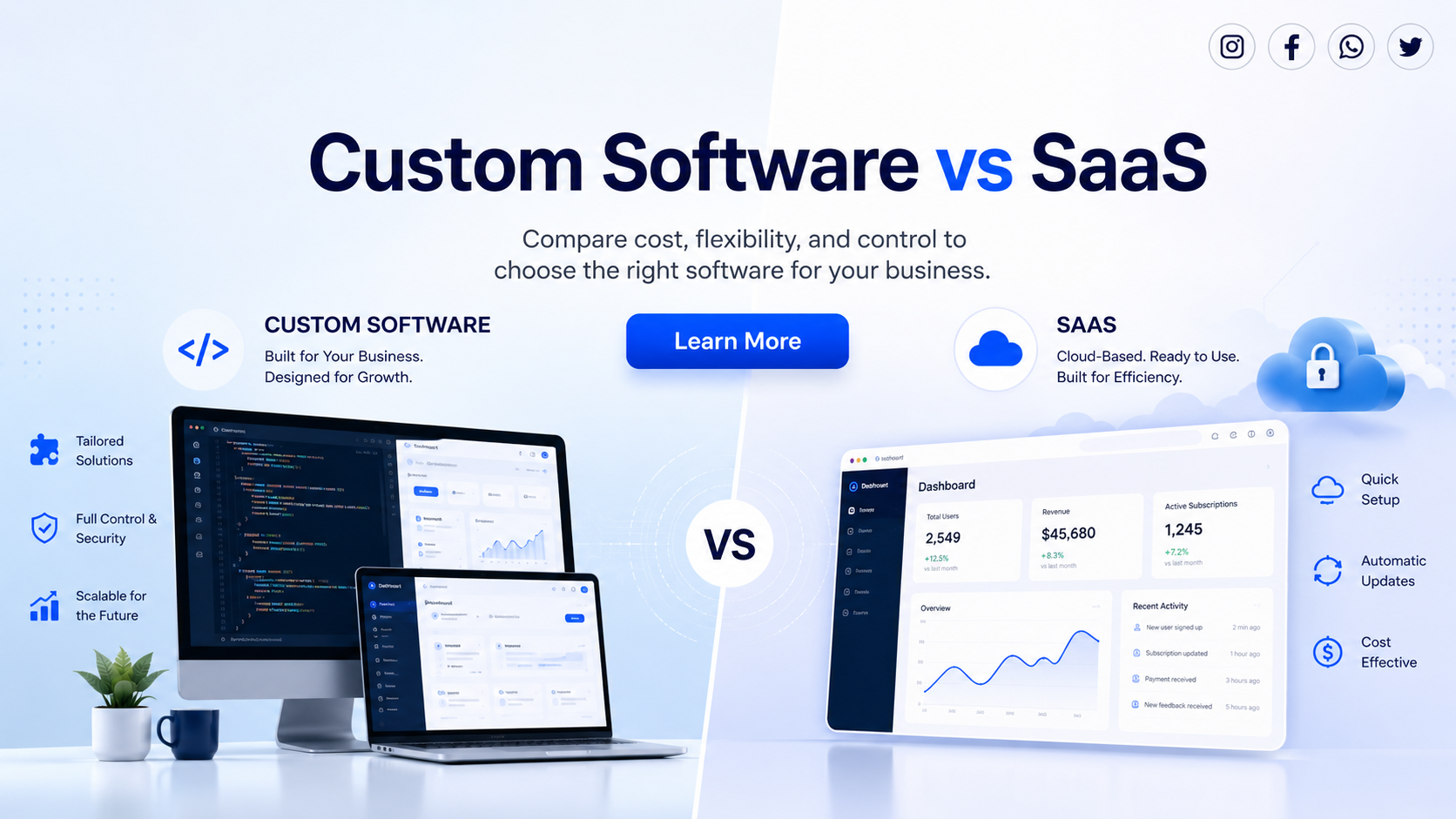
Choosing the right software is not only about features. It is about how your business works, how your team manages daily tasks, how much control you need, and how your operations will grow in the future.
Many businesses get confused between custom software and SaaS. SaaS is ready-made software that you can start using quickly through a subscription. Custom software is built specially for your business process, team, workflow, and long-term needs.
So, which one is right for your business?
The simple answer is this:
Choose SaaS when your process is simple and you need a quick solution. Choose custom software when your business has unique workflows, growing teams, custom reporting needs, automation needs, or long-term control requirements.
Let’s understand this in a clear and practical way.
Custom Software vs SaaS: Simple Difference
SaaS means Software as a Service. It is ready-made software available online. You usually pay monthly or yearly to use it. Common examples include CRM tools, accounting tools, HR tools, email marketing tools, project management tools, and customer support platforms.
Custom software is different. It is designed and developed according to your business requirement. Instead of adjusting your business around fixed software features, the software is built around your actual process.
For example, a small sales team may use a ready-made SaaS CRM to manage leads. But if a company needs custom lead stages, sales approval flow, branch-wise access, client history, quotation tracking, payment follow-ups, and ERP integration, then custom CRM software may be a better option.
This is the main difference:
SaaS gives you ready-made features. Custom software gives you business-fit features.

When SaaS Is the Better Choice
SaaS can be a good option when your business needs speed, simplicity, and low starting cost.
You can start quickly without spending time on software planning, design, development, testing, and deployment. Most SaaS tools are easy to set up and come with standard features that many businesses already use.
SaaS is useful when:
Your process is simple.
Your team is small.
You need software quickly.
You want a low starting cost.
You are testing a new business idea.
You do not need deep customization.
You are comfortable with monthly or yearly subscription pricing.
For example, if you only need a basic project management tool, email marketing tool, accounting software, or simple CRM, SaaS may be enough.
The biggest benefit of SaaS is that it saves time at the starting stage. You can subscribe, set up your account, add users, and start working.
But there is one important point to understand.
SaaS works well when your business process is standard. If your process becomes unique, complex, or difficult to manage inside fixed software features, SaaS may start creating limitations.
When Custom Software Is the Better Choice
Custom software is the better choice when your business cannot fully depend on ready-made software.
Every business does not work in the same way. Your sales process, customer journey, approval flow, reporting style, team roles, billing system, inventory method, or service process may be different from others.
In that case, using a ready-made SaaS tool may force your team to change the way they work. This can create confusion, manual work, duplicate entries, and poor visibility.
Custom software is useful when:
Your business process is unique.
Your team depends on manual work.
You are using Excel, WhatsApp, and multiple tools together.
You need custom dashboards and reports.
You need role-based access for different teams.
You need CRM, ERP, HRMS, billing, inventory, or website integration.
You want software built around your exact workflow.
You want better control over features, data, and future updates.
For example, a logistics company may need custom fleet tracking, delivery updates, driver management, billing, proof of delivery, and customer portal in one system. A ready-made SaaS tool may not support all of this properly.
In this situation, custom software development becomes a better long-term decision.
Cost Comparison: Starting Cost vs Long-Term Cost
Many businesses compare custom software and SaaS only by starting cost. This is not the right way to decide.
SaaS usually has a lower starting cost. You pay a monthly or yearly subscription and start using the software. This looks affordable in the beginning.
But as your team grows, the cost can increase. Many SaaS tools charge based on users, features, storage, automation, reports, or premium access. What looks low-cost today may become expensive after 1, 2, or 3 years.
SaaS cost usually includes:
Monthly subscription
Yearly subscription
User-based pricing
Feature-based pricing
Storage charges
Integration charges
Premium support charges
Custom software usually has a higher starting investment because it is planned, designed, developed, tested, and deployed according to your business need.
But in the long term, custom software can give better value when the software becomes important for your business operations.
Custom software cost usually includes:
Requirement planning
UI/UX design
Development
Testing
Deployment
Maintenance
Future upgrades
So the real question is not only:
Which option is cheaper today?
The better question is:
Which option will give better value, control, and efficiency in the next 3 to 5 years?
If your business only needs simple software, SaaS can be cost-effective. But if your business depends heavily on software for daily operations, customer management, sales tracking, automation, reporting, or team control, custom software can deliver better long-term value.

Flexibility: Fixed Features vs Business-Fit Features
Flexibility is one of the biggest differences between SaaS and custom software.
SaaS tools are made for a large number of users. They provide common features that can work for many businesses. You may get settings, templates, user roles, reports, and integrations, but only within the limits of that platform.
Custom software is built for your exact requirement.
You can decide:
How your dashboard should look
What data your team should see
Which reports are needed
How approvals should work
Which roles should have access
Which tools should be integrated
What automation should be added
How the customer journey should be managed
This is very important for businesses where the process is not simple.
For example, if your team is using one SaaS tool for CRM, another for billing, another for inventory, and Excel for reporting, then your process is already scattered. Custom software can bring these activities into one connected system.
The key insight is simple:
SaaS gives you what is already available. Custom software gives you what your business actually needs.
Ownership and Control
With SaaS, you do not fully own the software. You are using access to a platform through a subscription.
This means the vendor controls the platform, pricing, updates, feature changes, policies, and roadmap. If they change pricing, remove a feature, change rules, or limit access, your business has to adjust.
With custom software, you can get more control depending on your development agreement. You can decide how the software should work, what features should be added, what changes are required, and how the system should grow.
SaaS gives less control because:
The vendor controls updates.
The vendor controls pricing.
The vendor controls feature availability.
The vendor controls product direction.
Your business depends on their roadmap.
Custom software gives more control because:
You can plan features as per your needs.
You can upgrade based on your business growth.
You can create custom workflows.
You can connect with your existing systems.
You can build long-term software ownership.
If the software is only a support tool, SaaS can work. But if software directly supports your sales, operations, customers, team, reports, or service delivery, control becomes very important.
Scalability: Which Option Supports Growth Better?
SaaS can scale well when your needs are standard. You can add more users, upgrade the plan, and use more features.
But business growth does not only mean more users. Growth also means more complexity.
As your business grows, you may need:
Branch-wise control
Department-wise dashboards
Role-based access
Custom reports
Approval workflows
Advanced automation
Integration with ERP, CRM, HRMS, billing, inventory, or mobile apps
Customer portals
Vendor portals
Management dashboards
This is where custom software becomes stronger.
Custom software can be planned according to your current process and future growth. You can start with important features first and add more modules later as your business grows.
For example, you may begin with a custom CRM. Later, you can add quotation management, billing, customer support, inventory, reports, and mobile app access.
This makes custom software a scalable solution for businesses that want long-term digital growth.

Integration: One Tool vs Complete Business System
One common problem with SaaS is scattered data.
Many businesses use different tools for different activities. One tool for leads, one for accounts, one for HR, one for inventory, one for support, and one for reporting. This may work in the beginning, but later it creates confusion.
Your team may need to enter the same data again and again. Reports may not match. Managers may not get clear visibility. Important customer or business data may remain divided across different platforms.
Custom software can solve this problem by connecting different business functions into one system.
It can connect:
CRM, ERP, HRMS, Inventory, Billing, Reports, Mobile apps, Web portals, Customer dashboards, Third-party APIs, Payment gateways, WhatsApp or email notifications
If your team is spending too much time moving data from one tool to another, custom software can reduce manual work and improve business visibility.
This is one of the strongest reasons why growing businesses choose custom software development instead of depending only on SaaS tools.
Security and Data Control
Security is important for every business, but it becomes even more important for industries like healthcare, finance, logistics, real estate, manufacturing, education, and enterprise services.
With SaaS, security depends on the software provider. Most good SaaS companies provide strong security, but you still have limited control over how the system is built, where data is managed, and how access rules are structured.
With custom software, security can be planned according to your business needs.
You can add:
Role-based access
User permission control
Activity logs
Secure login
Data backup
Approval control
Department-wise access
Custom security rules
Data visibility restrictions
This is helpful when different teams should see different data.
For example, a sales executive may only need access to assigned leads. A manager may need team performance reports. The admin may need full control. Custom software can handle this properly.
If your business handles sensitive information, custom software gives better flexibility in planning data control and access management.
Custom Software vs SaaS: Quick Comparison
| Factor | SaaS | Custom Software |
| Starting Cost | Lower | Higher |
| Setup Time | Fast | Takes planning and development |
| Customization | Limited | High |
| Ownership | Subscription-based access | More control and possible ownership |
| Workflow Fit | Standard process | Exact business process |
| Scalability | Good for simple growth | Better for complex growth |
| Integration | Limited to available options | Built as per requirement |
| Reporting | Standard reports | Custom dashboards and reports |
| Data Control | Depends on provider | Planned as per business need |
| Best For | Simple and quick needs | Unique and growing business needs |
Choose SaaS If
SaaS can be the right option if your business needs a simple and fast solution.
Choose SaaS if:
You need software quickly.
Your process is simple.
Your team is small.
You want a low starting cost.
You are testing a new idea.
You do not need custom workflows.
You are comfortable with subscription pricing.
You can adjust your process according to the software.
SaaS is a practical choice when the software is not deeply connected to your core business operations.
Choose Custom Software If
Custom software can be the right option if your business needs control, flexibility, automation, and long-term value.
Choose custom software if:
Your business process is unique.
Your team is doing too much manual work.
You are using multiple tools but still lack clear visibility.
You need custom reports and dashboards.
You need approval workflows.
You need integration with other systems.
Your SaaS cost is increasing as your team grows.
You want software built around your exact business workflow.
You want long-term control over features and data.
Custom software is a stronger choice when software plays an important role in your business growth, operations, customer management, or internal productivity.
How to Decide the Right Software Option for Your Business
Before choosing between SaaS and custom software, ask yourself a few clear questions.
Is my business process simple or unique?
Do I need quick setup or long-term control?
Will my team grow in the next 1 to 3 years?
Do I need custom reports or dashboards?
Am I using too many disconnected tools?
Is my monthly SaaS cost increasing?
Do I need software ownership?
Do I need integration with CRM, ERP, billing, inventory, HRMS, or mobile apps?
Is my team still depending on Excel, WhatsApp, calls, and manual follow-ups?
Will ready-made software support my future business growth?
If most of your answers are simple, SaaS may be enough.
But if your answers involve custom workflow, automation, integration, reporting, team control, and long-term growth, custom software is the better option.
Custom Software vs SaaS: Which Is Better?
There is no single answer for every business.
SaaS is better when you need a fast, simple, and ready-made solution. It helps small teams and startups begin quickly without high upfront investment.
Custom software is better when your business needs flexibility, automation, ownership, scalability, and better control over daily operations.
A simple way to decide is this:
If software is only a basic support tool, SaaS can work well.
If software directly controls your sales, operations, customers, team, reports, or business growth, custom software can be a better long-term decision.
The right choice depends on your business process, budget, growth plan, team size, and future software needs.

Need Help Choosing Between SaaS and Custom Software?
Choosing the wrong software can waste time, budget, and team effort. Before investing, it is better to understand your workflow, feature needs, integration requirements, reporting goals, and long-term business plan.
If you are not sure whether your business needs SaaS or custom software, our software experts can help you choose the right direction.
Book a free software consultation and get clear guidance before you invest in your next business software solution.
FAQs
1. What is the main difference between custom software and SaaS?
SaaS is ready-made software used through a subscription. Custom software is built specially for your business process, team, workflow, and long-term needs.
2. Is SaaS cheaper than custom software?
SaaS usually has a lower starting cost. But the long-term cost can increase with more users, features, storage, and subscriptions. Custom software has a higher starting cost but can give better long-term value when your business needs control and customization.
3. When should a business choose custom software?
A business should choose custom software when it needs unique workflows, custom reports, automation, integrations, role-based access, and long-term control over features and data.
4. When is SaaS a better option?
SaaS is better when your business needs quick setup, simple features, low starting cost, and standard software functions without deep customization.
5. Can custom software replace multiple SaaS tools?
Yes, custom software can combine CRM, ERP, HRMS, billing, inventory, reporting, customer portals, and workflow automation into one connected system.
6. Which is better for growing businesses: SaaS or custom software?
SaaS can work for simple growth, but custom software is often better for growing businesses with complex workflows, multiple teams, custom reporting, and integration needs.
7. Is custom software good for small businesses?
Yes, custom software can be useful for small businesses when their process is unique, manual work is high, or ready-made SaaS tools do not fit their daily operations.
8. Should startups choose SaaS or custom software?
Startups can choose SaaS when they want to test ideas quickly. But if the software is the main product or core business system, custom software may be a better choice.