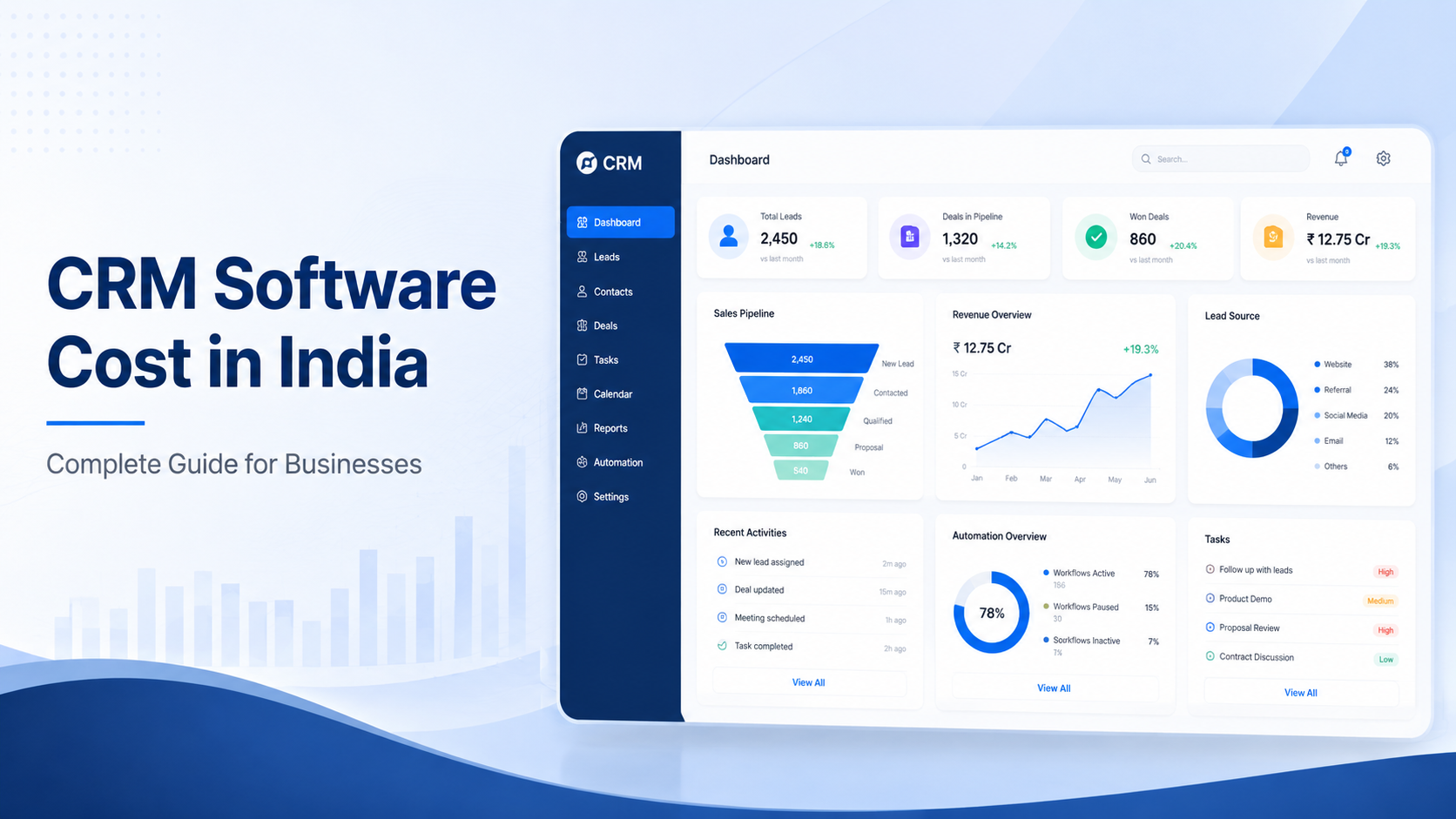
Managing customer data, sales follow-ups, leads, and business operations manually becomes difficult as a business grows. Many companies start with Excel sheets, WhatsApp chats, and disconnected tools, but after a certain point, it starts affecting productivity, customer experience, and sales performance.
That is where CRM software becomes important.
One of the most common questions businesses ask before planning a CRM system is:
“How much does CRM software cost in India?”
The answer is not always simple because CRM software cost in India depends on many factors such as features, customization level, integrations, automation requirements, mobile accessibility, scalability, and business size.
Some businesses may only need a simple lead management system, while others may require a complete custom CRM platform integrated with ERP systems, WhatsApp automation, payment gateways, reporting dashboards, and mobile applications.
In this guide, we will explain everything in a simple and practical way, including:
- CRM software pricing in India
- Feature-wise CRM development cost
- Factors affecting CRM pricing
- Industry-wise CRM cost estimation
- Hidden costs businesses often ignore
- Custom CRM vs ready-made CRM
- How to reduce CRM development cost smartly
If you are planning to invest in CRM software for your business, this article will help you understand the complete picture before making a decision.
What is CRM Software?
CRM stands for Customer Relationship Management. It is a software system that helps businesses manage leads, customers, sales activities, communication history, follow-ups, and workflows from one centralized platform.
Instead of handling everything manually, CRM software organizes business operations in a more structured and efficient way.
A CRM system can help businesses:
- Track customer inquiries
- Manage sales pipelines
- Automate follow-ups
- Store customer information
- Generate reports
- Improve team coordination
- Monitor sales performance
Today, businesses from almost every industry use CRM software to improve productivity and customer management.
For example, a real estate company may use CRM software to track property inquiries and site visits, while a healthcare business may use CRM software for appointment scheduling and patient communication.
Businesses looking for scalable and customized CRM systems often prefer working with a professional CRM software development company to build solutions based on their workflow requirements.
Why Businesses Need CRM Software Today
As businesses grow, managing operations manually becomes difficult. Teams start missing follow-ups, customer data gets scattered, and sales processes become inconsistent.
Without a proper CRM system, businesses often face problems like:
- Lost leads
- Delayed responses
- Poor customer tracking
- Lack of sales visibility
- Manual reporting
- Communication gaps between teams
CRM software helps solve these operational issues by creating a centralized workflow system.
Modern CRM platforms are no longer limited to contact management. Businesses now integrate CRM systems with WhatsApp, email automation, AI tools, customer support systems, inventory management, and ERP platforms.
Many companies also combine CRM systems with AI integration and automation services to reduce repetitive tasks and improve operational efficiency.
For businesses managing large lead volumes, using a proper lead management software can significantly improve conversion tracking and sales follow-ups.

Average CRM Software Cost in India
CRM software cost in India can vary from ₹80,000 to ₹15,00,000 or more depending on business requirements.
The final cost depends on how simple or advanced the CRM system needs to be.
Basic CRM Software Cost
A basic CRM system usually costs between ₹80,000 to ₹2,50,000.
This type of CRM generally includes:
- Lead management
- Customer database
- Basic reporting
- Contact management
- Follow-up reminders
Basic CRM systems are suitable for startups and small businesses that want to organize customer management without advanced automation.
Mid-Level CRM Software Cost
A mid-level CRM software solution generally costs between ₹2,50,000 to ₹7,00,000.
These CRM systems may include:
- Workflow automation
- Sales pipeline tracking
- WhatsApp integration
- Reporting dashboards
- Role-based access
- Email automation
- Mobile responsiveness
This category is commonly preferred by growing businesses that want better operational control and automation.
Businesses planning scalable CRM systems often work with experienced software consulting services to identify the right features and avoid unnecessary development expenses.
Enterprise CRM Software Cost
Enterprise CRM software development in India can range from ₹7,00,000 to ₹15,00,000+.
Enterprise-level CRM systems usually include:
- Advanced automation
- AI-based workflows
- ERP integration
- Multi-branch management
- Enterprise security
- Advanced analytics
- Cloud infrastructure
- Mobile applications
Large organizations often require highly customized systems built specifically around their business operations.
Companies searching for enterprise-grade solutions often explore enterprise software development services for scalable and secure CRM platforms.
Major Factors Affecting CRM Software Development Cost
One of the biggest reasons CRM software cost in India varies so much is because every business has different operational requirements.
Here are the major factors that directly affect CRM development pricing.
Features and Functionalities
The number of features plays a major role in CRM software cost.
A simple CRM with contact management will cost much less compared to a system that includes:
- Workflow automation
- AI chatbot integration
- Reporting dashboards
- Multi-user access
- Inventory tracking
- Payment integration
- Sales analytics
More features require more development time, testing, and maintenance.
Customization Level
Some businesses only need minor customization, while others require completely custom workflows.
Custom CRM software development costs more because developers build the platform specifically according to business operations.
Businesses needing fully tailored systems often prefer customized software development services to match their operational workflow properly.
UI/UX Design
A clean and user-friendly dashboard improves productivity and user adoption.
Advanced CRM dashboard design, mobile responsiveness, and user experience improvements can increase development cost, but they also improve long-term usability.
Many businesses invest in professional UI/UX design services to create better CRM interfaces for teams.
Third-Party Integrations
CRM systems often need integrations with:
- WhatsApp API
- Email systems
- ERP software
- Payment gateways
- SMS services
- Inventory software
These integrations increase development complexity and overall CRM implementation cost.
Businesses combining CRM and ERP workflows often explore ERP software development solutions for centralized business management.
Mobile Application Development
Many businesses now want CRM access through Android and iOS mobile apps.
Developing mobile CRM applications increases development time and cost because separate testing and optimization are required.
Companies planning mobile-first CRM platforms often work with a professional mobile app development company for better scalability and performance.

Also Read This: Questions to Ask Before Hiring a Mobile App Development Team
Security and Scalability
Industries like finance, healthcare, and enterprise operations require stronger security and scalable infrastructure.
Advanced security features, cloud architecture, and large database handling can increase CRM software development cost significantly.
Feature-Wise CRM Development Cost Breakdown
Understanding feature-wise CRM pricing helps businesses plan budgets more accurately.
Lead Management Module
Lead management is one of the most important CRM features. It helps businesses track inquiries, customer interactions, and follow-ups.
Approximate development cost:
₹40,000 – ₹1,20,000
WhatsApp Integration
WhatsApp CRM integration allows businesses to manage customer communication directly from the CRM dashboard.
Approximate cost:
₹25,000 – ₹1,00,000
Reporting Dashboard
Reporting dashboards help businesses monitor sales performance, lead conversion, and team productivity.
Approximate cost:
₹50,000 – ₹2,00,000
Workflow Automation
Automation features reduce manual work and improve operational efficiency.
Approximate cost:
₹80,000 – ₹3,00,000
Businesses planning automation-focused systems often integrate CRM workflows with AI automation solutions for better productivity.
Mobile CRM Application
Mobile CRM apps allow teams to access customer data from anywhere.
Approximate cost:
₹1,50,000 – ₹5,00,000+
CRM Software Cost Based on Business Size
Different businesses require different CRM capabilities, which directly affects pricing.
| Business Size | CRM Requirements | Cost in India |
| CRM for Startups | Startups usually prefer affordable and scalable CRM solutions with essential features like lead management, customer tracking, and basic reporting. | ₹80,000 – ₹2,00,000 |
| CRM for Small Businesses | Small businesses often require workflow automation, reporting dashboards, better lead management, and customer communication tools. | ₹2,00,000 – ₹5,00,000 |
| CRM for Medium Businesses | Medium-sized businesses generally need advanced workflows, third-party integrations, multi-user access, and department coordination features. | ₹5,00,000 – ₹10,00,000 |
| CRM for Enterprises | Enterprise organizations require highly scalable and customized CRM systems with advanced security, automation, analytics, and enterprise-level integrations. | ₹10,00,000+ |
Industry-Wise CRM Software Cost in India
CRM software requirements vary depending on industry operations.
Real Estate CRM Software Cost
Real estate CRM systems usually include:
- Property inquiry tracking
- Broker management
- Site visit scheduling
- Follow-up automation
Approximate cost:
₹2,50,000 – ₹8,00,000
Businesses in this sector often prefer specialized real estate software development solutions for better workflow management.
You can also explore this real estate CRM case study to understand how CRM systems improve operational efficiency.
Healthcare CRM Software Cost
Healthcare CRM systems may include:
- Patient management
- Appointment scheduling
- Notifications
- Medical record integration
Approximate cost:
₹3,00,000 – ₹12,00,000
Healthcare businesses often require secure and scalable healthcare software development services for patient data management.
Education CRM Software Cost
Education CRM systems help manage student inquiries, admissions, and communication workflows.
Approximate cost:
₹2,00,000 – ₹7,00,000
Institutions planning scalable systems often explore education and eLearning software development for customized student management platforms.
Custom CRM vs Ready-Made CRM
This is one of the most important decisions businesses face while planning CRM software.
Ready-Made CRM
Ready-made CRM platforms are faster to implement and usually cheaper initially.
However, they may have limitations in:
- customization
- scalability
- workflow flexibility
- ownership
Businesses using SaaS-based platforms often face recurring monthly costs and limited customization options over time.
Custom CRM Software
Custom CRM software is built specifically around business requirements.
Advantages include:
- tailored workflows
- better scalability
- full ownership
- flexible integrations
- long-term efficiency
Businesses looking for fully scalable solutions often choose custom CRM software development services instead of relying only on ready-made systems.

Hidden CRM Development Costs Businesses Often Ignore
Many businesses only focus on initial development cost and ignore long-term operational expenses.
Some hidden CRM costs may include:
- hosting charges
- API usage fees
- maintenance cost
- security updates
- cloud infrastructure
- technical support
- scaling expenses
- third-party subscription charges
Ongoing support is important for maintaining CRM performance and security. Businesses often invest in software support and maintenance services for long-term system stability.
How Long Does CRM Development Take?
CRM software development timeline depends on project complexity.
Basic CRM
Usually takes around 1–2 months.
Mid-Level CRM
Generally takes 3–5 months.
Enterprise CRM
May take 6 months or longer depending on integrations and customization requirements.
Proper planning and consultation can help reduce delays and improve project execution.
How to Reduce CRM Development Cost Smartly
Reducing CRM software cost does not mean compromising quality. Smart planning can help businesses optimize budgets effectively.
A practical approach is to start with core features first and expand later as business requirements grow.
Businesses can also reduce expenses by:
- avoiding unnecessary features
- planning integrations early
- using scalable architecture
- choosing experienced development teams
- focusing on MVP development initially
Working with experienced software project consulting experts can help businesses avoid common planning mistakes.
Signs Your Business Needs Custom CRM Software
Many businesses delay CRM implementation until operational problems become serious.
Some common signs include:
- managing leads in Excel sheets
- missing follow-ups
- poor sales visibility
- disconnected communication
- manual reporting
- multiple scattered tools
- difficulty tracking customer history
If these issues are affecting daily operations, investing in a proper CRM system can improve productivity and workflow management significantly.
How to Choose the Right CRM Development Company in India
Choosing the right development partner is just as important as planning the CRM itself.
A good CRM development company should understand:
- business workflows
- scalability planning
- user experience
- integrations
- security requirements
- future growth
Before selecting a company, businesses should review:
- portfolio
- case studies
- communication process
- support structure
- technology expertise
Working with an experienced software development company in Mumbai can help businesses build scalable and reliable CRM solutions according to operational requirements.
You can also explore these software development case studies to understand how custom software solutions are implemented across industries.

Future Trends in CRM Software Development
CRM software is evolving rapidly as businesses focus more on automation and customer experience.
Some major CRM trends include:
- AI-powered automation
- WhatsApp CRM integration
- cloud-based CRM systems
- predictive analytics
- mobile-first CRM platforms
- voice-enabled workflows
- CRM and ERP integration
Businesses investing in scalable systems today are focusing more on automation, analytics, and customer engagement tools for long-term operational growth.
Frequently Asked Questions
How much does CRM software cost in India?
CRM software cost in India generally ranges between ₹80,000 to ₹15,00,000+ depending on features, integrations, automation requirements, and business size.
Is custom CRM better than ready-made CRM?
Custom CRM software is usually better for businesses that need scalability, workflow flexibility, and long-term operational efficiency.
How long does CRM development take?
Basic CRM systems may take 1–2 months, while enterprise CRM software can take 6 months or more.
What affects CRM software pricing the most?
Major factors include features, integrations, customization level, mobile apps, automation, and security requirements.
Can CRM integrate with WhatsApp?
Yes, modern CRM systems can integrate with WhatsApp APIs for communication management and customer support workflows.
Final Thoughts
CRM software is no longer just a sales management tool. It has become an important part of modern business operations.
The right CRM system can help businesses improve customer management, automate workflows, increase team productivity, and create better operational visibility.
However, CRM software cost in India depends entirely on business requirements, scalability goals, integrations, and customization needs.
Instead of focusing only on the lowest development price, businesses should focus on long-term value, operational efficiency, scalability, and future growth.
Planning the right CRM architecture from the beginning can help avoid unnecessary expenses and operational challenges later.
If you are planning a CRM solution for your business, discussing your workflow requirements with an experienced software development team can help you get a more accurate understanding of CRM software development cost and feature planning according to your business goals.