
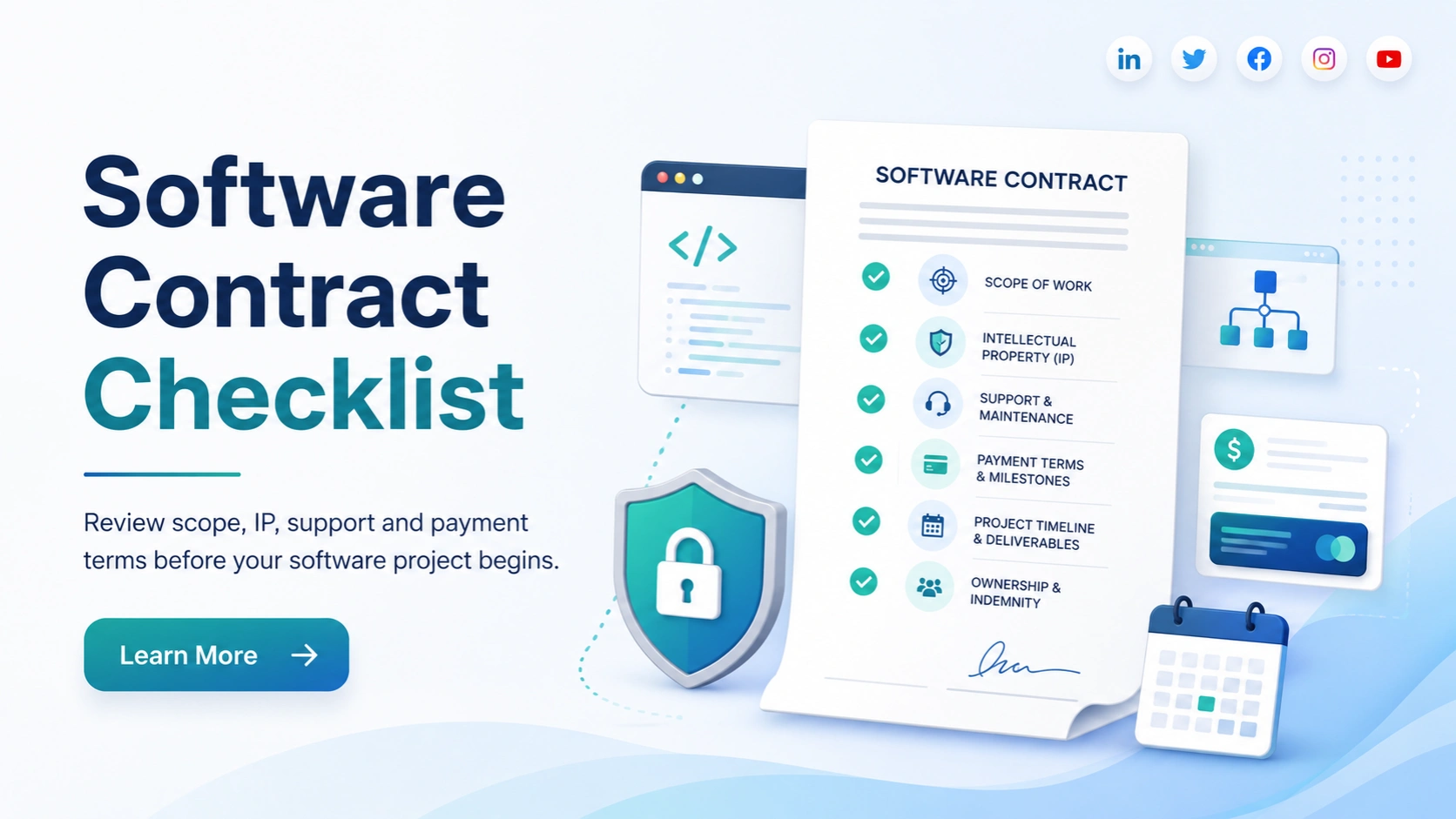
A software development contract should make the project easier to understand before development starts. It should clearly explain what will be built, what is outside the scope, how changes will be handled, when payments become due, who owns the software, and what support is available after launch.
Many software project disputes do not begin with poor development. They begin with unclear expectations.
A feature may have been discussed but never added to the agreed scope. A milestone may be considered complete by the development team while the client still expects additional work. Source-code ownership may be assumed rather than documented. Support may be included without explaining exactly what it covers.
This software development contract checklist is designed for business owners, founders, CTOs and procurement teams who already understand the basics and want to know what they should specifically verify before signing a custom software development contract.
This guide provides general business and technical information and should not be treated as legal advice. Software agreements can vary by project type, country, jurisdiction and business situation. Important legal terms should be reviewed by qualified legal counsel.
Software Development Contract Checklist: What Should You Review First?
Before signing a software development agreement, focus on the areas that can create the biggest commercial or operational risk.
| Contract Area | What You Need to Confirm |
| Scope | Exact functionality, platforms, integrations and exclusions |
| Deliverables | What code, designs, documentation and other assets will be provided |
| Timeline | Milestones, dependencies and responsibility for delays |
| Acceptance | How completed work will be tested and approved |
| Change Requests | How additional requirements affect cost and delivery |
| Payment | Deposit, milestone payments and final payment conditions |
| IP Ownership | Who owns the software and when ownership transfers |
| Source Code | Repository access, source-code rights and handover |
| Third-Party Tools | APIs, licenses, subscriptions and external costs |
| Warranty | Which defects are fixed without extra development charges |
| Support | What happens after launch and how support is provided |
| Termination | What happens if the relationship ends early |
| Handover | Code, credentials, infrastructure and documentation |
| Liability | Legal responsibilities, limitations and dispute provisions |
The purpose of the contract is not to predict every possible situation. Its purpose is to remove the most important areas of uncertainty before they become a project problem.

Make the Software Project Scope More Specific Than a Feature List
Most businesses already know that a software development scope of work should be included in the agreement. The more important question is whether that scope is detailed enough to guide development, testing, payment and final acceptance.
A statement such as “development of a custom CRM according to client requirements” explains the general intention of the project, but it does not clearly define what the development company has actually agreed to build.
A stronger scope should identify the major modules, user roles, platforms, integrations and expected functionality. For a CRM, for example, that might include customer management, lead management, user permissions, sales pipeline, reporting, notifications, import and export functionality, API integrations and an administrative dashboard.
The contract should go further when a module contains several important functions. “Customer Management” can mean very different things to two people. One side may expect simple customer records, while the other expects search, filters, activity tracking, import, export, assignment, segmentation and automated workflows.
Clear scope reduces the number of decisions that later depend on memory, emails, chats or verbal conversations.
Do Not Ignore Scope Exclusions
A strong scope also explains what is not included.
This becomes particularly important when the project depends on services such as cloud hosting, third-party APIs, SMS providers, payment gateways, Apple Developer accounts, Google Play fees, data migration or ongoing content entry.
If these responsibilities are not clear, clients may reasonably assume they are included while the development company may treat them as separate work.
A useful test before signing is:
Could someone who was not present in the sales meetings understand what is included and excluded simply by reading the agreement?
If not, the scope probably needs more detail.
2. Separate Requirements, Deliverables and Business Outcomes
Requirements, deliverables and outcomes are connected, but they are not the same.
A requirement explains what the software needs to do. A deliverable explains what the software company is expected to provide. A business outcome explains the result the client hopes to achieve.
For example, a requirement might state that sales managers need to export customer data. The deliverable may be a working CSV and Excel export feature. The expected business outcome may be faster reporting and easier customer analysis.
This distinction matters because a software development company can generally control the quality and functionality of what it builds, but it cannot fully control every business result that follows.
A CRM can provide lead tracking and sales automation, but the developer cannot guarantee that the client’s sales revenue will increase by a certain percentage. An ERP can automate business processes, but it cannot guarantee operational improvement if internal processes are not followed correctly.
A well-structured software development agreement should therefore focus contractual commitments on measurable requirements and deliverables rather than vague business outcomes.
3. Define Exactly What the Client Will Receive
The finished software is only part of the final project handover.
Depending on the project, the client may also expect source code, design files, technical documentation, API documentation, database structures, test reports, deployment scripts, cloud configuration, credentials, mobile app builds and repository access.
These assets should not be assumed.
The contract should clearly identify what will be provided during development and what will be transferred when the project is completed.
For example, if the development company creates a mobile application with a backend system, the client may need more than the Android and iOS applications. Another development team may later require access to the backend source code, database structure, API documentation, cloud environment and deployment process.
A simple question can expose whether the deliverables are defined properly:
If the software development company stopped working with us after final payment, what exactly would we receive?
The answer should already be visible in the contract.
4. Connect Project Milestones to Real Deliverables
A software project timeline becomes much more useful when milestones represent actual, measurable progress rather than broad development phases.
A timeline that says “Design in Month 1, Development in Month 2, Testing in Month 3 and Launch in Month 4” may help with planning, but it does not necessarily define what must be completed before the next payment or milestone begins.
A stronger approach connects the deliverable, target delivery date, acceptance criteria and payment trigger.
For example, a CRM milestone could cover customer creation, editing, search, filters, import, export and permission controls. The agreement could specify the target delivery period, explain how the client will test the functionality, and state that the related milestone payment becomes due after acceptance.
This creates a clearer relationship between development progress and commercial obligations.
If you also publish a separate guide about the custom software development timeline, this section creates a natural internal-link opportunity without changing the primary intent of the current article.
5. Clarify What Happens When the Development Timeline Changes
Software development timelines rarely depend on the development company alone.
Project delays can come from late approvals, missing content, changing requirements, delayed API credentials, unavailable client stakeholders, third-party services, payment gateway approvals, app-store reviews or technical dependencies.
A well-written contract should define how these situations affect delivery commitments.
For example, if the client takes three weeks to approve a design that was expected to be reviewed within five business days, the original development schedule may no longer be realistic. The agreement should explain whether project dates move automatically or whether a revised timeline must be approved.
The same applies to external dependencies. An Apple App Store review, payment gateway approval or third-party API outage may sit outside the direct control of both the client and the development company.
A realistic contract does not simply promise a date. It explains the assumptions behind that date.
This is particularly important for larger systems where the ERP development timeline or enterprise project schedule depends heavily on integrations, data migration, internal approvals and user acceptance testing.

6. Define Acceptance Criteria Before Connecting Them to Payment
One of the most important questions in a software development contract is simple:
When is a feature actually considered complete?
The development company may believe a module is complete when coding and internal testing are finished. The client may consider it complete only after their users have tested the functionality and confirmed that it meets the agreed requirement.
Neither interpretation should be left to assumption.
Software acceptance criteria create a shared definition of completion.
For example, a payment module may only be accepted when users can complete the payment flow, failed transactions are handled correctly, required notifications are triggered and agreed payment-gateway scenarios pass testing.
The contract should also define how long the client has to review a milestone. A reasonable review period prevents deliverables from remaining open indefinitely while still giving the client enough time to test important functionality.
It should also explain what constitutes a valid rejection.
If the approved requirement says that invoices must export as PDF and the feature does not generate a correct PDF, the issue is measurable. If the client simply says the feature is “not what we imagined,” it becomes much more difficult to determine whether the original requirement was satisfied.
Clear acceptance criteria make milestone payments more objective and reduce disputes over what “complete” means.
7. Create a Formal Change Request Process
Software requirements often change during development.
That does not automatically mean the original planning failed. Businesses learn more about their workflows once they start seeing the product, and new requirements can emerge during implementation.
The important part is how those changes are handled.
A proper software development change request should explain the requested change, why it is needed, how much additional work it requires, whether it affects other modules, how much it will cost and whether the delivery timeline needs to change.
The normal process should be straightforward:
Request → Impact Review → Cost and Timeline Estimate → Approval → Development
One of the most useful distinctions in this section is the difference between a bug, a change and a new feature.
If the approved requirement states that GST should be included in an invoice calculation and the software calculates it incorrectly, that is usually a defect against the requirement.
If the approved system works correctly but the client later decides that they also want multi-currency invoices, that is a change or additional feature.
Without this distinction, almost every request after development begins can become a disagreement about whether it should be included in the original price.
8. Structure Software Development Payment Terms Around Progress
Software development payment terms should be simple enough that both sides know when a payment becomes due and what must happen before it is invoiced.
Different projects use different commercial models. Some are fixed-price, some are billed on a time-and-materials basis, while dedicated teams may be billed monthly.
No single payment structure is correct for every project.
What matters is that the contract clearly explains the deposit, milestone payments, payment due dates, taxes, third-party expenses, additional development charges and final payment conditions.
For milestone-based development, tying payments to accepted deliverables is generally easier to understand than relying only on calendar dates.
For example:
“25% due on 15 October” explains when the client must pay but not what progress is expected.
“25% due after acceptance of the Customer Management and Reporting modules” connects the payment with a measurable project event.
Payment terms should also explain how approved change requests are billed and what happens if payment is delayed.
9. Understand What Software IP Ownership Actually Includes
Software IP ownership is one of the most important areas to clarify before signing a custom software development contract.
Businesses sometimes assume that paying for development automatically means they own every piece of code, technology and intellectual property used in the application.
That assumption can be risky.
The contract should distinguish between assets that existed before the project and assets created specifically for the project.
A software company may already own development frameworks, reusable libraries, internal tools or general-purpose components that it uses across several client projects. These are often described as background IP.
Project-specific IP may include custom workflows, business logic, project-specific interfaces, designs, documentation, database structures and custom source code created for the client’s system.
The agreement should explain whether each category is transferred, licensed or retained.
It should also specify when ownership transfers. Some agreements connect IP transfer to full payment, while other projects may use different arrangements.
WIPO recommends clearly addressing ownership, background intellectual property, transfer timing, open-source components, confidentiality, termination and support within software development agreements.
The key point is that ownership should be documented, not assumed.
10. Review Source-Code Ownership Separately
Source-code ownership deserves more attention than a single sentence saying that the client owns the software.
The agreement should clarify whether the client will have access to the source-code repository during development, whether full repository history will be transferred, when ownership takes effect, and which reusable or third-party components remain licensed rather than transferred.
The practical reason is continuity.
A client should understand whether another qualified development company could maintain or extend the application if the original development relationship ended.
This leads to one of the most useful questions in the entire contract review:
If we replaced the development company tomorrow, could another capable software team continue the project without depending completely on the original vendor?
If the source code, deployment process, documentation, cloud infrastructure and credentials are all controlled by the vendor, the business may have a significant dependency problem even if the contract says the client “owns the software.”
11. Check Third-Party Software, APIs and Open-Source Components
Most modern applications depend on technology that was not written specifically for the project.
A custom application might use a payment gateway, SMS service, email provider, maps API, cloud service, analytics platform, AI API, open-source framework or third-party authentication provider.
The contract should explain who is responsible for these external dependencies.
For example, if the application depends on a paid API, the client should understand who owns the account, who pays the subscription, what happens if usage exceeds the plan limit and what happens if the provider changes its pricing.
Open-source software requires similar attention.
Open source does not simply mean “free to use without conditions.” Different licenses can carry different permissions and obligations.
WIPO recommends considering the effect of open-source components when defining ownership and licensing rights in software agreements.
For larger or security-sensitive projects, businesses may also want better visibility into the software dependencies used in the application. NIST guidance discusses Software Bills of Materials, or SBOMs, as one approach to improving visibility into software components and supply-chain risk.
The goal is not to avoid third-party technology. Modern software relies on it extensively. The goal is to understand the dependency before the software becomes dependent on it.
12. Clarify Who Controls Hosting, Accounts and Infrastructure
Source-code ownership is important, but businesses should also understand who controls the environment in which the software operates.
That may include the domain, DNS, AWS or Azure account, Google Cloud, GitHub, GitLab, Firebase, Apple Developer account, Google Play Console, email provider, payment gateway, analytics platform and database infrastructure.
Imagine that the contract ends while every production account is registered using the vendor’s company email address.
Even when the client owns the application, moving the project to a different software company can become unnecessarily difficult.
Where practical, important business accounts should normally sit under the client’s organization, with controlled access given to the development company.
This keeps the client in control without preventing the technical team from doing its work.

13. Define Data Access, Security and Confidentiality
Software development teams often need access to sensitive information during implementation and maintenance.
Depending on the project, that may include customer records, financial information, employee data, passwords, API keys, production databases, business processes and proprietary source code.
The contract should therefore clarify who can access sensitive systems, how credentials are handled, whether subcontractors can access data, what happens if a security incident occurs and what happens to client data after the engagement ends.
The required level of security should also match the nature of the application.
A small internal scheduling tool does not carry the same risk profile as banking software, healthcare software, fintech platforms or enterprise systems containing sensitive customer information.
The agreement should therefore connect security expectations to the actual system being developed instead of relying only on a generic confidentiality sentence.
14. Separate Warranty, Bug Fixing, Support and Maintenance
The phrase “free support for three months” appears in many software proposals, but it can mean almost anything unless the agreement defines it.
Warranty, support, maintenance, bug fixing and enhancements are related services, but they solve different problems.
| Term | What It Generally Covers |
| Warranty | Defects in functionality that was originally agreed |
| Bug Fixing | Correcting functionality that does not work as specified |
| Support | Assistance with operational or usage problems |
| Maintenance | Keeping the software functional, compatible and updated |
| Enhancement | Adding or changing functionality |
Suppose the approved requirement says that a user can register using email and password.
If registration stops working because of a defect in the original code, the issue may fall within warranty or bug fixing.
If the client later asks for Google, Apple and LinkedIn login options, that is new functionality rather than a defect.
This distinction should be clear before post-launch support begins.
15. Make Post-Launch Support Measurable
A software support agreement becomes more useful when it explains how support is actually provided.
The contract may define the support period, available support channels, service hours, response expectations, escalation process, included support hours and additional support charges.
For larger business systems, issues can also be categorized by severity.
A complete production outage might be classified as critical. A major module that does not work could be considered high priority. A minor visual issue may be considered low priority.
The important point is not the exact terminology. It is whether both sides understand how different issues will be treated.
Response time and resolution time should also be distinguished.
A development company may be able to commit to acknowledging a critical issue within a defined period, but the actual fix can depend on the complexity of the problem, third-party dependencies and testing requirements.
16. Define What Happens If the Contract Ends Early
Not every software project reaches the final launch with the same vendor.
The client may change priorities. The vendor may fail to perform. Payment problems can occur. Business conditions can change. Either party may decide that continuing the relationship no longer makes sense.
A software development contract termination clause should explain what happens in those circumstances.
The important questions are practical.
What happens to completed source code? What happens to unfinished work? Which payments remain due? Will the client receive repository access? What happens to design files, technical documentation and production credentials? How will the client’s data be returned or deleted?
Partially completed work also deserves attention. The agreement should explain whether the client receives usable work produced before termination and whether any IP transfer depends on outstanding payments.
These legal terms should be reviewed by qualified counsel because termination rights can vary significantly based on jurisdiction and contract wording.
17. Include a Complete Software Project Handover
A proper software handover should make the project understandable to someone other than the original development team.
The client may require current source code, repository access, database structure, deployment instructions, API documentation, design files, cloud access, credentials, environment configuration, known issues and technical documentation.
Complex systems may also require knowledge-transfer sessions.
Documentation can explain how the software works, but direct walkthroughs can be useful when another development team needs to understand the architecture, deployment process, database design or major integrations.
WIPO also recommends addressing source code, documentation, passwords and support obligations when software development relationships end.
The objective of handover is continuity.
The software should not become impossible to maintain simply because the people who originally built it are no longer involved.
18. Check for Vendor Lock-In Before You Sign
Vendor lock-in is not always created intentionally.
It often develops gradually when the software company controls the repository, cloud accounts, deployment process, documentation, database access and third-party services.
A project can work perfectly while the original development company is involved, but become difficult to maintain when the business wants to switch vendors.
A few warning signs deserve particular attention:
- The client cannot access the source-code repository.
- Important production accounts belong only to the vendor.
- Technical documentation is missing.
- Deployment depends on undocumented internal processes.
- Third-party accounts are registered under vendor-controlled details.
- The agreement has no clear transition or handover requirement.
The main question is straightforward:
Can the business continue operating and developing the software if the vendor relationship ends?
If the answer depends entirely on the current software company, the contract deserves another review.
19. Clarify Whether Subcontractors Can Work on the Project
A client may sign a contract with one software development company while some parts of the project are completed by subcontractors.
That is not automatically a problem.
The important point is clarity around confidentiality, security, IP ownership and responsibility.
If subcontractors are allowed, the primary software company should still remain clear about its obligations for quality, delivery, confidentiality and any intellectual property created by those subcontractors.
For projects involving sensitive business data or strict compliance requirements, clients may also want visibility into which external parties can access systems or confidential information.
20. Review Liability, Indemnification and Dispute Terms Carefully
Some sections of a software development agreement are primarily technical or commercial.
Liability, indemnification and dispute provisions are different.
These clauses can affect responsibility for data loss, confidentiality breaches, IP infringement, third-party claims, damages and other legal risks.
They may also define governing law, jurisdiction and the process used when disputes cannot be resolved informally.
These provisions should not be evaluated simply by deciding whether the wording appears fair.
Their legal effect can vary based on the contract, location and applicable law. Important agreements should therefore be reviewed by qualified legal counsel.
Software Development Contract Red Flags
A long contract is not necessarily a clear contract.
Before signing, take another look if you notice any of the following:
- The scope only says “as per client requirements.”
- Important deliverables are not defined.
- Payments are based only on dates rather than measurable progress.
- There are no acceptance criteria.
- The change-request process is missing.
- IP or source-code ownership is unclear.
- The client has no repository or infrastructure access.
- Third-party costs and licenses are not disclosed.
- “Support included” has no defined scope or duration.
- The contract has no clear termination or handover process.
These issues do not automatically make a contract unacceptable, but they are areas that deserve clarification before development begins.
Questions to Ask a Software Development Company Before Signing
A detailed contract becomes easier to evaluate when you ask practical questions.
Start with scope: Can you show us exactly what is included and excluded?
For deliverables: What will our company receive when development is completed?
For timeline: Which client or third-party dependencies could move the delivery date?
For acceptance: How will we decide that a milestone has been completed successfully?
For change requests: What happens to price and delivery if we add functionality after development begins?
For payment: What specific event triggers each milestone payment?
For IP: What software assets will our company own after payment?
For source code: Will we have access to the repository and version history?
For third-party technology: Which APIs, licenses or paid services will the application depend on?
For support: What happens after launch, and what is included without additional development charges?
For termination: What happens to our source code, data, documentation and credentials if we stop working together?
These questions move the conversation away from assumptions and toward measurable responsibilities.

How the Contract Changes by Software Project Type
The core contract principles remain similar across software projects, but different systems create different risks.
Mobile App Development Contract
Mobile app agreements should pay particular attention to Android and iOS requirements, supported operating-system versions, device compatibility, backend infrastructure, push notifications, third-party SDKs and app-store responsibilities.
The app development duration may also depend partly on Apple or Google review processes. The agreement should therefore distinguish development time from external approval time.
Apple Developer and Google Play accounts should also be discussed early so the client understands who owns the published application and related store assets.
SaaS Development Contract
SaaS development agreements require additional clarity around cloud infrastructure, user accounts, subscription billing, data storage, multi-tenant architecture, authentication, deployment, scalability, monitoring and ongoing maintenance.
The contract should also make data ownership and third-party platform dependencies clear.
Because SaaS platforms are often continuously developed after the first release, the agreement should distinguish the initial development scope from ongoing product development.
ERP Development Contract
An ERP development timeline often depends on much more than coding.
Data migration, department approvals, integrations, user roles, reporting, business rules and user acceptance testing can all affect the project schedule.
The contract should therefore define modules and dependencies carefully.
For example, Finance, Inventory, Procurement and HR may each have separate requirements and approval responsibilities. Treating the entire ERP as one large deliverable can make progress difficult to measure.
CRM Development Contract
CRM agreements should describe how customer records, leads, pipelines, tasks, reports, permissions, imports, integrations and automation are expected to work.
Data migration deserves particular attention.
If an existing CRM contains years of customer records, the contract should define whether migration includes only transfer or also data cleaning, duplicate removal and field mapping.
Those are very different scopes of work.
Enterprise Software Development Contract
Enterprise systems usually require stronger alignment around security, scalability, integrations, service levels, infrastructure, documentation, compliance, access controls and vendor continuity.
The larger and more business-critical the system becomes, the more dangerous it is to rely on assumptions.
Enterprise software contracts should therefore make technical dependencies and operational responsibilities unusually clear.
Use the 6C Software Contract Test
A long software agreement can be simplified into six practical checks.
Clarity: Can both parties clearly understand what will and will not be developed?
Completion: Is there an objective way to determine when a deliverable is finished?
Change: Is there a documented process for changing requirements, cost and timeline?
Control: Who controls the source code, data, infrastructure and critical accounts?
Continuity: Can the business continue using and maintaining the software if the vendor relationship changes?
Cost: Does the agreement explain exactly when and why the client pays?
If one of these areas depends mainly on verbal discussions rather than written terms, it should be clarified before the contract is signed.
Final Software Development Contract Checklist
Before approving the agreement, confirm the following essential points:
- The project scope and important exclusions are clearly documented.
- Deliverables and project milestones are measurable.
- Acceptance criteria and review periods are defined.
- Change requests have a clear approval, pricing and timeline process.
- Payment triggers and final payment conditions are understood.
- IP and source-code ownership are clearly addressed.
- Third-party software, licenses and ongoing costs are disclosed.
- Repository, hosting and infrastructure access are defined.
- Warranty, support and maintenance responsibilities are separated.
- Termination and software handover requirements are documented.
- Important liability and legal provisions have been professionally reviewed.
Final Takeaway
A strong software development contract should remove uncertainty before development begins.
The most important areas can be reduced to four ideas:
Scope → Acceptance → Ownership → Continuity
Scope explains exactly what is being built. Acceptance criteria define how both sides know that the work is complete. IP and source-code terms explain what the client controls. Support, maintenance, termination and handover terms determine whether the software can continue supporting the business after launch or after a vendor change.
A contract cannot guarantee that a software project will never face delays, changes or technical challenges.
What it can do is make the process for handling those situations much clearer.
Before beginning a custom software, mobile app, CRM, ERP, SaaS or enterprise software project, discuss the scope, deliverables, timeline, dependencies, payment structure, intellectual property, source-code access and post-launch responsibilities in detail.
That discussion is often just as important as the final contract itself.
Planning a custom software project? Speak with our software development team to discuss your requirements, technical scope, integrations, development approach and expected project timeline before development begins.
Frequently Asked Questions
What should be included in a software development contract?
A software development contract should clearly define the project scope, deliverables, milestones, acceptance criteria, payment terms, change-request process, intellectual property rights, source-code ownership, third-party services, warranty, support, maintenance, termination and handover requirements.
Who owns the source code after software development?
Source-code ownership depends on the software development agreement, applicable law and any third-party or developer-owned components used in the project. The contract should clearly state who owns project-specific code, when ownership transfers and what components remain licensed.
How should software development payments be structured?
Software projects may use milestone payments, fixed-price billing, time-and-materials billing or monthly development fees. For milestone projects, payment is easier to manage when it is linked to clearly defined and accepted deliverables.
What are software acceptance criteria?
Software acceptance criteria are measurable conditions used to determine whether a feature or milestone meets the approved requirements. They may cover functionality, integrations, user permissions, supported devices, reports, data flow, testing results and defect severity.
What happens if software requirements change during development?
The project should use a documented change-request process. The development company evaluates the requested change, estimates the additional effort, explains the cost and timeline impact, and begins the additional work after approval.
Is software maintenance included after development?
Not automatically. Development, warranty, support and maintenance are different services. The contract should explain what is included after launch, how long the coverage lasts and what requires an additional fee.
What happens to source code if the software contract is terminated?
The answer depends on the termination, payment and ownership provisions in the agreement. The contract should explain what happens to completed source code, unfinished work, repository access, documentation, client data and credentials if the project ends early.
Should a client control the cloud and production accounts?
For important business applications, client-controlled ownership of core production accounts can reduce vendor dependency and make future transitions easier. The exact arrangement depends on the project, but ownership and access should be clearly documented.
Should a lawyer review a software development contract?
Legal review is advisable for significant software projects, particularly when the contract involves intellectual property, sensitive data, substantial investment, complex licensing, regulatory obligations or material business risk. Technical teams can define project requirements, while qualified legal counsel should review legal rights and obligations.