
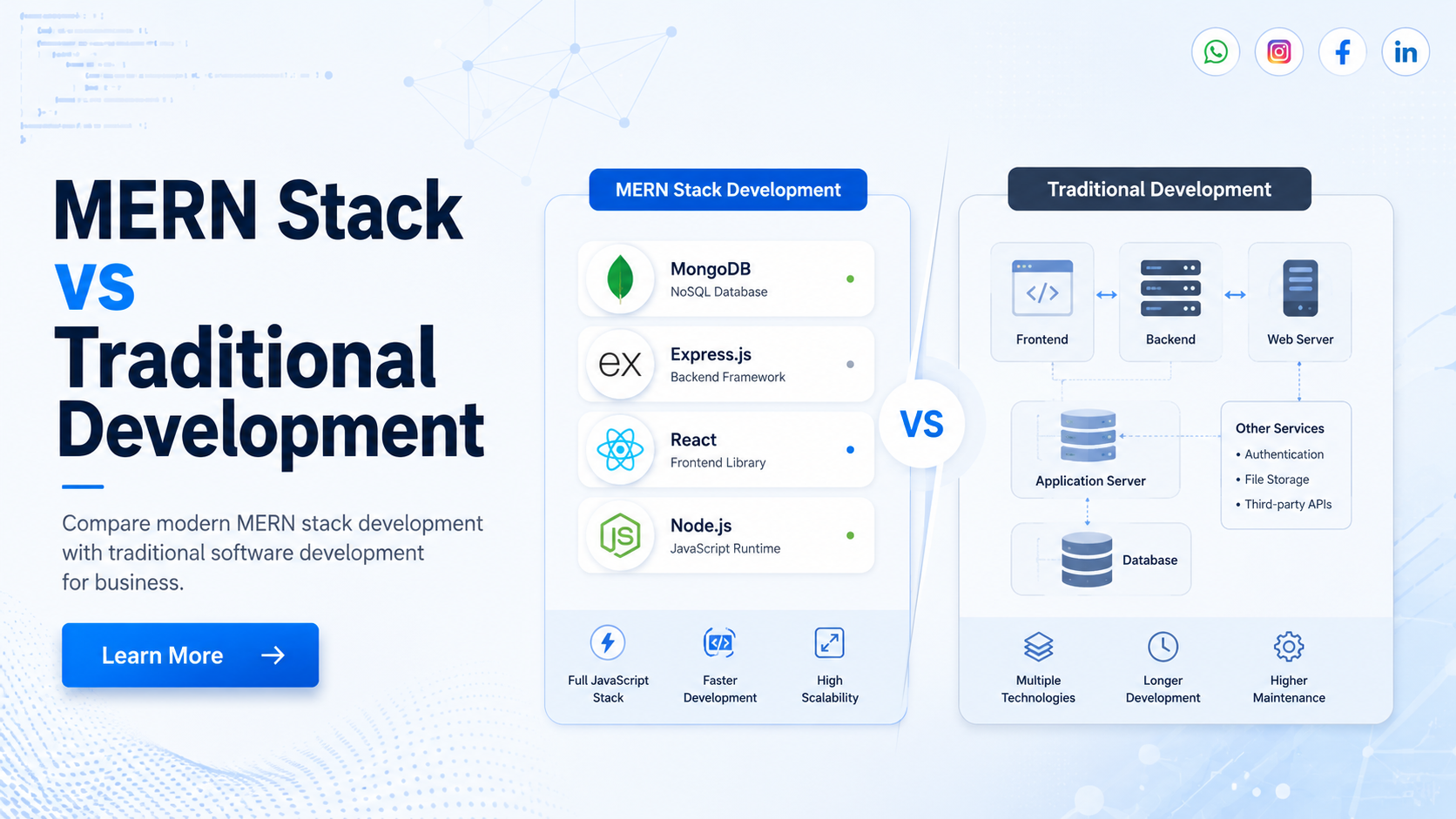
Choosing the right technology for a web application is one of the most important decisions before starting development. Many businesses, startups, and product owners get confused between MERN stack development and traditional development.
Both options can build good software. But they are not the same. The right choice depends on your project type, budget, timeline, scalability needs, team skills, integrations, and long-term maintenance plan.
MERN stack is popular for modern web applications, SaaS platforms, dashboards, portals, and real-time applications. Traditional development is still used for many enterprise systems, legacy applications, large business software, and projects that need a more structured technology approach.
So, the main question is not only “Which one is better?” The better question is: Which one is right for your business project?
This guide explains the difference between MERN stack vs traditional development in simple words, so you can make a better decision in less time.
What Is MERN Stack?
MERN stack is a modern web development stack that uses JavaScript for both frontend and backend development.
MERN stands for:
MongoDB – database
Express.js – backend framework
React.js – frontend library
Node.js – backend runtime environment
In simple words, MERN stack helps developers build full web applications using one main language: JavaScript.
This makes development faster and more connected because the frontend and backend can work smoothly together. It is commonly used for modern web apps, SaaS products, admin dashboards, customer portals, ecommerce platforms, booking systems, CRM tools, and real-time applications.
What Is Traditional Development?
Traditional development usually means building software using older or more established technology combinations. This may include languages and frameworks like PHP, Java, .NET, Python, MySQL, PostgreSQL, server-side rendering, monolithic architecture, or enterprise frameworks.
Traditional development is not outdated. It is still useful for many business applications, enterprise software, banking systems, government projects, internal company tools, and legacy system upgrades.
In traditional development, the frontend, backend, and database may use different technologies. For example, a project may use PHP with MySQL, Java with Oracle, or .NET with SQL Server.
This approach can be stable and powerful, especially for large systems that need strict structure, security, and long-term enterprise support.

MERN Stack vs Traditional Development: Main Difference
The biggest difference is the development approach.
MERN stack uses JavaScript across the full application. This helps developers build fast, modern, and interactive web applications. It is more flexible for startups, SaaS platforms, dashboards, and web products that need quick development and frequent updates.
Traditional development may use different technologies for frontend, backend, and database. It can be more structured and suitable for enterprise systems, legacy software, and complex business processes.
Here is a simple comparison:
| Factor | MERN Stack | Traditional Development |
| Main Language | JavaScript | PHP, Java, .NET, Python, etc. |
| Best For | Modern web apps, SaaS, dashboards, real-time apps | Enterprise systems, legacy apps, structured business software |
| Development Speed | Usually faster for modern apps | Depends on stack and project complexity |
| Flexibility | High | Medium to high |
| Scalability | Good when planned properly | Strong for large enterprise systems |
| Maintenance | Easier if JavaScript team is available | Stable if the right enterprise team is available |
| Database | MongoDB by default | MySQL, PostgreSQL, SQL Server, Oracle, etc. |
| UI Experience | Strong for dynamic interfaces | Depends on frontend approach |
Advantages of MERN Stack Development
MERN stack has become popular because it supports fast and modern web application development.
1. Faster Development
Since MERN stack uses JavaScript across the frontend and backend, development can be faster. Developers can work with one common language, which reduces complexity.
This is useful for startups and businesses that want to launch an MVP or web application quickly.
2. Better for Modern User Interfaces
React.js is one of the main parts of MERN stack. It helps create fast, dynamic, and interactive user interfaces.
If your application needs dashboards, real-time updates, user panels, admin screens, charts, filters, and smooth navigation, MERN stack can be a strong option.
3. Good for SaaS and Web Applications
MERN stack is widely used for SaaS platforms, subscription-based products, CRM systems, business portals, marketplaces, and web applications.
It supports API-based architecture, which makes it easier to connect with mobile apps, third-party tools, payment gateways, CRMs, and external services.
4. Strong Developer Community
MERN stack has a large developer community. React and Node.js are widely used, which makes it easier to find developers, libraries, tools, and support.
This can help reduce development time and improve long-term maintainability.
5. Suitable for Real-Time Features
MERN stack is useful for applications that need real-time features such as live chat, notifications, activity tracking, dashboards, collaboration tools, and instant updates.
Node.js works well for handling real-time communication when planned properly.
Limitations of MERN Stack
MERN stack is powerful, but it is not perfect for every project.
1. Not Always Ideal for Heavy Enterprise Systems
If your project has very complex enterprise workflows, strict compliance rules, or legacy system dependency, MERN may not always be the best first choice.
Traditional technologies like Java, .NET, or enterprise-grade relational database systems may be better in some cases.
2. Requires Good Architecture Planning
MERN stack can scale well, but only if the architecture is planned properly. Poor database structure, weak API design, or unplanned code can create performance issues later.
This is why businesses should work with an experienced MERN stack development company instead of only focusing on quick delivery.
3. MongoDB May Not Fit Every Data Model
MongoDB is flexible, but not every business needs a NoSQL database. Some businesses need strong relational data structures, complex transactions, and strict reporting.
For example, finance, accounting, banking, or inventory-heavy systems may sometimes work better with relational databases like PostgreSQL, MySQL, or SQL Server.

Advantages of Traditional Development
Traditional development still has strong value, especially for large and structured projects.
1. Strong for Enterprise Applications
Traditional development is often preferred for enterprise applications that need strict workflows, user roles, approval systems, security rules, and long-term stability.
Java, .NET, PHP, Python, and relational databases are still used by many businesses because they are mature and reliable.
2. Better for Legacy System Integration
Many businesses already have old software systems. If your new application needs to connect with existing legacy systems, traditional development may sometimes be easier.
This is common in finance, manufacturing, logistics, healthcare, and enterprise operations.
3. Strong Relational Database Support
Traditional development often uses relational databases like MySQL, PostgreSQL, SQL Server, and Oracle.
These databases are useful when your project needs structured data, complex reporting, accounting logic, transactions, and strong data relationships.
4. Mature Security and Compliance Support
Traditional technologies have been used for many years in industries with strict security needs. This makes them suitable for banking, insurance, healthcare, government, and enterprise projects.
Limitations of Traditional Development
Traditional development also has some limitations.
1. Development Can Take More Time
Some traditional development approaches may take more time because the frontend, backend, and database are often handled separately.
This can increase coordination work and development time, especially for modern UI-based applications.
2. Less Flexible for Fast Product Changes
If your business needs to test features quickly, update the product often, or build a fast MVP, traditional development may feel slower compared to MERN stack.
3. Modern UI May Need Extra Frontend Work
Traditional development can build modern interfaces, but it may require extra frontend frameworks or additional development planning.
MERN stack already includes React, which is strong for building dynamic user interfaces.
MERN Stack vs Traditional Development: Cost Comparison
The cost of development depends on the project, not only the technology.
MERN stack development may be cost-effective for startups, MVPs, SaaS platforms, dashboards, portals, and web applications because one JavaScript-based team can manage both frontend and backend.
Traditional development may cost more or less depending on the technology, team experience, project complexity, and integration requirements.
Cost usually depends on:
Project features
UI/UX design
Backend complexity
Database structure
Third-party integrations
Security requirements
Testing and deployment
Maintenance and support
Developer experience
For example, a simple MERN stack dashboard may be faster and more affordable than building the same product with a complex traditional architecture.
But for a large enterprise system with strict compliance, relational database needs, and legacy integration, traditional development may be more suitable even if the cost is higher.
So, do not choose only based on price. Choose based on business goals and long-term value.
MERN Stack vs Traditional Development: Performance and Scalability
Both MERN stack and traditional development can perform well if they are built correctly.
MERN stack is good for modern web applications, API-based systems, and real-time features. Node.js can handle many requests efficiently, and React helps create fast user interfaces.
Traditional development can also be highly scalable, especially for large enterprise systems built with Java, .NET, or strong backend frameworks.
The real performance depends on:
Code quality
Database design
Server setup
API structure
Caching
Security setup
Hosting infrastructure
Testing and optimization
A badly built MERN application can be slow. A badly built traditional application can also be slow.
Technology matters, but planning and execution matter more.

MERN Stack vs Traditional Development: Security
Security is not only about the technology stack. It depends on how the application is planned, developed, tested, and maintained.
MERN stack applications can be secure if developers follow proper practices such as secure authentication, input validation, API protection, access control, encryption, and regular updates.
Traditional development is also secure when built with proper architecture and compliance planning.
For finance, healthcare, legal, and enterprise projects, security should be planned from the beginning. The right development team should consider user roles, data protection, audit logs, backup, server security, and compliance needs.
Best Use Cases for MERN Stack
MERN stack is a strong choice when your business needs a modern, fast, and flexible web application.
MERN stack is suitable for:
SaaS platforms
Startup MVPs
CRM systems
Admin dashboards
Customer portals
Real-time chat applications
Booking platforms
Marketplace platforms
Ecommerce web apps
Business automation tools
Project management systems
Analytics dashboards
Collaboration platforms
Choose MERN stack if your project needs modern UI, faster development, API-based structure, real-time features, and regular product updates.
Best Use Cases for Traditional Development
Traditional development is better when your project needs strong structure, mature backend logic, legacy support, or complex business rules.
Traditional development is suitable for:
Enterprise software
Banking and finance systems
Healthcare applications
Government portals
Large internal business systems
Legacy software modernization
Accounting and billing platforms
Manufacturing ERP systems
Compliance-heavy applications
Complex relational database systems
Choose traditional development if your project needs deep enterprise workflow, legacy integration, strong relational database structure, or strict compliance.
MERN Stack vs Traditional Development for Startups
For startups, MERN stack is often a good choice because it supports faster development, flexible updates, and MVP building.
A startup usually needs to launch quickly, test the market, collect feedback, and improve features. MERN stack supports this type of development well.
But if the startup product is in finance, healthcare, or an industry with strict compliance, the technology decision should be made carefully.
MERN can still work, but the architecture must be planned properly.
MERN Stack vs Traditional Development for Business Applications
For business applications, the decision depends on the process.
If your business needs a CRM, dashboard, customer portal, workflow automation system, or reporting tool, MERN stack can be a strong option.
If your business needs a large ERP system, accounting-heavy platform, or software that connects with legacy tools, traditional development may be better.
The best approach is to first understand the business workflow and then choose the technology.
MERN Stack vs Traditional Development for SaaS Products
MERN stack is a strong option for SaaS product development because it supports scalable web applications, user dashboards, subscription systems, APIs, and modern interfaces.
Many SaaS products need frequent updates and a smooth user experience. React helps with the frontend experience, while Node.js supports API-based backend development.
However, SaaS architecture needs proper planning for security, multi-user access, database structure, billing, performance, and future growth.
Which One Should You Choose?
Choose MERN stack development if you need:
A modern web application
Fast MVP development
SaaS platform
Interactive dashboard
Real-time features
API-based system
Customer portal
Startup product
Flexible and scalable web app
Choose traditional development if you need:
Enterprise software
Legacy system integration
Complex relational database
Strict compliance
Large internal system
Banking or finance platform
Heavy backend workflows
Long-term structured architecture
The right choice depends on your business goal, not only the technology trend.

Quick Decision Guide
If your main goal is speed, modern UI, and flexible product development, MERN stack can be a good choice.
If your main goal is enterprise stability, complex data relationships, and legacy system support, traditional development may be better.
If you are still confused, start with a technical consultation. A good software development company will first understand your workflow, users, features, budget, and future plans before suggesting a technology stack.
Need Help Choosing the Right Technology Stack?
Choosing between MERN stack and traditional development can be difficult if you are not from a technical background.
Aimbeat helps businesses plan and build custom web applications, SaaS platforms, dashboards, portals, CRM systems, and business software based on the right technology approach.
As a software development company in Mumbai, we help businesses choose the right stack based on project goals, budget, timeline, scalability, integrations, and long-term maintenance.
If you are planning a new software project and want to know whether MERN stack or traditional development is right for your business, connect with Aimbeat for a clear consultation.
FAQs
Q1. Is MERN stack better than traditional development?
MERN stack is better for modern web applications, SaaS products, dashboards, real-time apps, and MVP development. Traditional development may be better for enterprise systems, legacy software, compliance-heavy applications, and complex relational database projects.
Q2. What is the main difference between MERN stack and traditional development?
MERN stack uses JavaScript across frontend and backend development. Traditional development may use different technologies such as PHP, Java, .NET, Python, MySQL, or SQL Server for different parts of the application.
Q3. Is MERN stack good for startups?
Yes, MERN stack is good for many startups because it supports faster development, modern UI, flexible updates, and MVP building. It is useful when a startup wants to launch quickly and improve the product over time.
Q4. Is MERN stack good for enterprise applications?
MERN stack can be used for enterprise applications if the architecture is planned properly. However, some enterprise projects may still need traditional technologies because of compliance, legacy systems, or complex data requirements.
Q5. Is MERN stack faster to develop?
For many modern web applications, MERN stack can be faster because frontend and backend use JavaScript. This helps developers work with a more connected development process.
Q6. Is MERN stack secure?
MERN stack can be secure when developers follow proper security practices such as secure login, API protection, validation, encryption, access control, and regular updates.
Q7. When should I choose traditional development instead of MERN stack?
Choose traditional development when your project needs legacy system support, strong relational database structure, enterprise-grade compliance, or complex backend workflows.
Q8. Is MERN stack suitable for SaaS application development?
Yes, MERN stack is suitable for SaaS application development because it supports modern dashboards, API-based architecture, user management, subscription features, and scalable web applications.


