Local businesses run on daily speed. Customers call, staff members manage work, orders come in, payments need tracking, bookings need confirmation, and the owner wants clear reports at the end of the day. In the beginning, many local businesses manage everything through WhatsApp, Excel sheets, notebooks, phone calls, or different small tools.
This may work for some time. But when the business starts growing, manual work becomes difficult to control. Customer follow-ups get missed, billing mistakes happen, stock records become unclear, staff updates are not tracked properly, and the business owner does not get a clear view of daily operations.
This is where custom software development for local businesses becomes useful. Custom software helps local shops, clinics, restaurants, salons, gyms, consultants, repair services, real estate brokers, coaching classes, and service providers manage their daily work from one organized system.
Instead of adjusting your business process according to a ready-made tool, custom software is built around the way your local business actually works.
Why Local Businesses Need Custom Software Today
Local businesses are no longer only offline businesses. Customers now expect quick replies, smooth booking, proper billing, timely updates, easy payment options, and better service experience.
A restaurant customer wants order updates.
A clinic patient wants appointment reminders.
A salon customer wants easy booking.
A gym member wants membership and renewal updates.
A retail shop owner wants stock clarity.
A real estate broker wants lead follow-up tracking.
A service business wants job status and technician updates.
When all these things are handled manually, the business becomes dependent on memory, staff updates, and scattered records. This creates confusion and slows down growth.
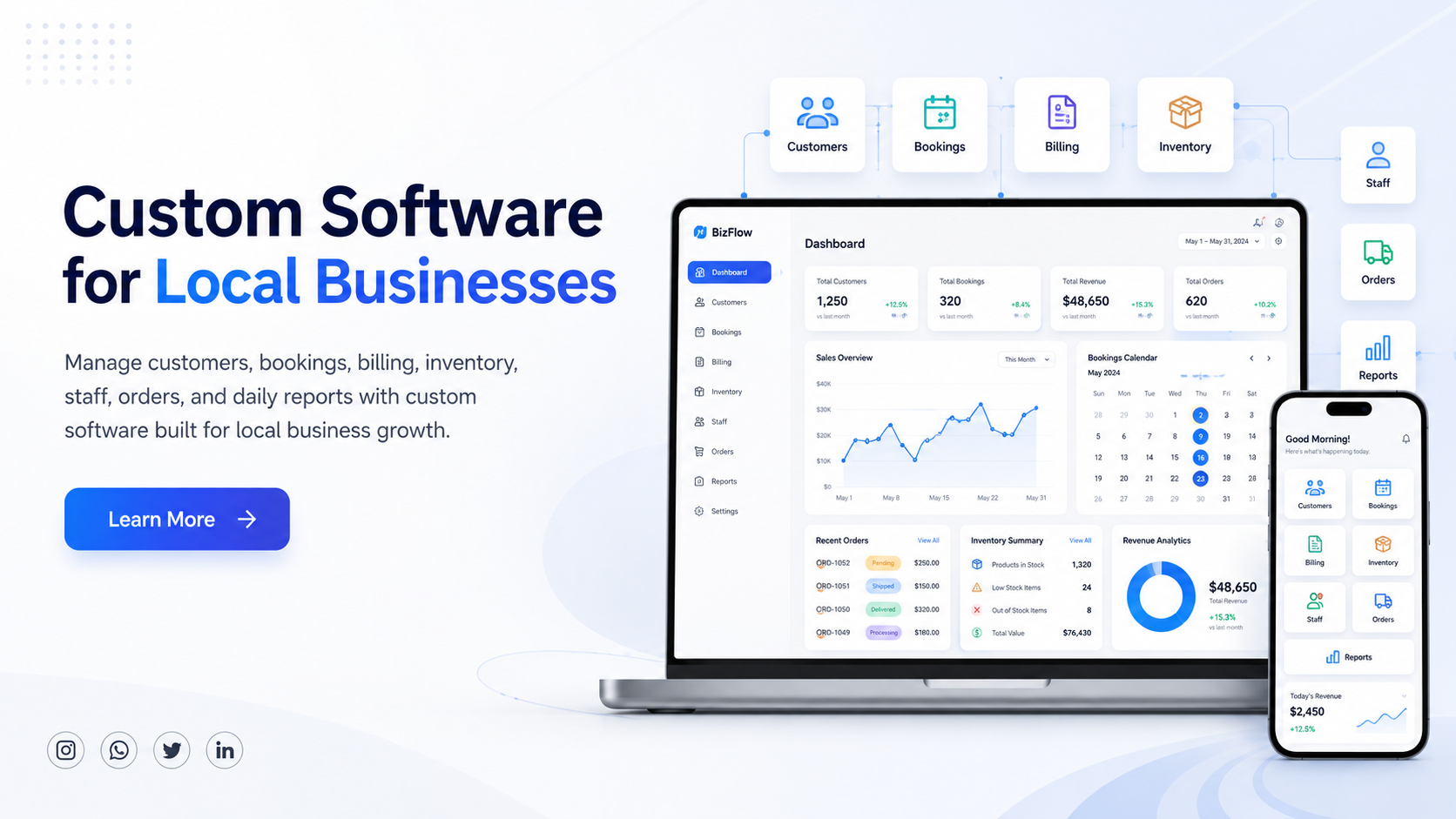
Custom software helps local businesses bring customer records, bookings, billing, inventory, staff work, payments, orders, and reports into one simple system. It gives business owners better control and helps teams work with more clarity.

Common Problems Local Businesses Face Without Proper Software
Many local businesses do not face problems because of lack of effort. They face problems because their daily process is not organized in one system.
Some common problems include:
Missed customer follow-ups
Many leads come through calls, WhatsApp, website forms, walk-ins, referrals, or social media. Without a proper system, follow-ups get missed and potential customers go to competitors.
Manual billing mistakes
When billing is managed manually, there can be errors in pricing, discounts, payment records, pending amounts, or invoice details.
No clear customer history
Staff may not know what the customer purchased earlier, which service they used, what issue they had, or when the next follow-up is needed.
Booking confusion
Clinics, salons, consultants, gyms, restaurants, and service businesses often face double bookings, missed appointments, or unclear time slots.
Inventory mismatch
Retail shops, food businesses, repair businesses, and product-based local businesses often struggle with stock updates, low-stock alerts, purchase records, and product movement.
Staff tracking issues
Business owners may not know who handled which task, which customer was contacted, which order is pending, or which staff member is responsible for a job.
No proper daily reports
Without software, owners may not get clear reports on sales, orders, payments, pending work, inventory, bookings, and customer activity.
Data scattered everywhere
Important business data stays in WhatsApp chats, notebooks, Excel files, staff phones, and different tools. This makes decision-making difficult.
Custom software solves these problems by creating one connected system for daily business operations.
What Is Custom Software for Local Businesses?
Custom software for local businesses is a digital system developed according to the specific process of your business. It can be a web application, custom mobile app, CRM, booking system, billing software, inventory management system, staff management system, customer portal, or business dashboard.
The main purpose is simple: to make your daily work easier, faster, and more organized.
For example, a local clinic may need appointment booking, patient records, prescription history, billing, and reminder features. A salon may need appointment scheduling, customer packages, staff allocation, and payment tracking. A retail shop may need inventory, billing, customer records, and daily sales reports.
Both are local businesses, but their software requirements are different. That is why custom software is valuable. It is not built as a one-size-fits-all tool. It is built around your actual business workflow.
Types of Local Businesses That Can Use Custom Software
Custom software can be useful for many types of local businesses. The features may change depending on the business type, but the goal remains the same: better control, less manual work, and smoother operations.
Retail Shops
Retail businesses can use custom software for billing, inventory tracking, customer records, purchase history, stock alerts, supplier records, offers, and daily sales reports. It helps the owner understand which products are selling, which stock is low, and how the business is performing.
Restaurants and Food Businesses
Restaurants, cloud kitchens, cafes, and food businesses can use custom software for order management, table booking, delivery tracking, kitchen coordination, billing, online orders, customer feedback, and loyalty programs.
Clinics and Healthcare Centers
Clinics can use custom software for appointment booking, patient records, prescription history, billing, follow-up reminders, doctor schedules, and reports. It helps reduce waiting time and improves patient management.
Salons and Spas
Salons and spas can use custom booking software to manage appointments, staff schedules, customer history, service packages, payments, reminders, and repeat visits.
Gyms and Fitness Centers
Gyms can use software for membership management, trainer allocation, workout plans, attendance, payment tracking, renewal reminders, and member progress records.
Repair and Service Businesses
Repair shops and service providers can manage service requests, technician assignments, job status, customer updates, spare parts, billing, and warranty records through custom software.
Real Estate Brokers
Real estate brokers can use CRM software to manage leads, property records, customer preferences, site visits, follow-ups, deal status, and team activity.
Coaching Classes and Training Institutes
Training institutes can use custom software for student records, batch management, attendance, fees, reminders, online classes, test reports, and performance tracking.
Consultants and Local Agencies
Consultants, local agencies, and service firms can manage leads, client communication, proposals, invoices, project status, task updates, and reports with custom business software.

Custom Software Solutions Local Businesses Can Build
Every local business does not need the same type of software. The right solution depends on your business process, customer flow, team size, and growth plan.
Custom CRM Software
A custom CRM helps local businesses manage leads, customers, follow-ups, communication history, reminders, sales stages, and team activity. It is useful for service businesses, consultants, real estate brokers, agencies, clinics, and local companies that depend on inquiries and customer follow-ups.
Appointment Booking Software
Appointment booking software is useful for clinics, salons, spas, consultants, gyms, trainers, repair services, and service providers. It helps manage time slots, staff schedules, booking confirmations, reminders, cancellations, and customer updates.
Billing and Invoice Software
Custom billing software helps businesses create invoices, manage receipts, track payments, check pending amounts, apply discounts, and maintain clean financial records. This is useful for shops, clinics, service providers, coaching classes, and local agencies.
Inventory Management Software
Inventory software helps track stock, purchases, sales, suppliers, low-stock alerts, product movement, and warehouse records. It is useful for retail shops, food businesses, repair services, ecommerce sellers, and product-based local businesses.
Order Management Software
Order management software helps businesses track orders from inquiry to delivery. It can manage order status, delivery updates, payment status, customer communication, and staff responsibility.
Staff Management Software
Staff management software helps local businesses manage attendance, tasks, roles, work updates, performance, approvals, and daily responsibilities. It helps owners understand who is doing what and what work is pending.
Business Dashboard
A business dashboard gives the owner a clear view of sales, revenue, customers, bookings, orders, payments, inventory, staff performance, and daily reports. Instead of asking different people for updates, the owner can see important information in one place.
Customer Mobile App or Portal
Some local businesses may also need a customer app or portal. Customers can book services, track orders, view history, make payments, raise requests, download invoices, and contact the business easily.
How Custom Software Helps Local Businesses Grow
Custom software is not only about technology. It is about improving the way your business works every day.
It helps local businesses:
Reduce manual work
Improve customer follow-ups
Save time in daily operations
Reduce billing and record mistakes
Track staff work more clearly
Manage bookings, orders, and payments better
Keep customer data organized
Get clear business reports
Improve customer experience
Make faster business decisions
Prepare the business for future growth
For local businesses, even small improvements can make a big difference. If follow-ups are done on time, sales can improve. If stock is tracked properly, losses can reduce. If staff tasks are clear, work becomes smoother. If customers get better service, repeat business increases.
Custom software helps create this control.
Custom Software vs Ready-Made Software for Local Businesses
Many local business owners first think about using ready-made software. That can be a good option when the requirement is very basic and standard.
But ready-made software may not fit every local business. Your process may be different. Your customer flow may be different. Your reporting needs may be different. Your staff roles may be different. Your business may need specific integrations or custom features.
Here is a simple comparison:
| Point | Ready-Made Software | Custom Software |
| Business Fit | Standard features | Built around your process |
| Flexibility | Limited | Highly flexible |
| Features | Fixed features | Features based on your needs |
| Scalability | May become limited | Can grow with your business |
| Control | Vendor-controlled | Business-controlled |
| Integrations | Limited options | Can integrate with required tools |
| Best For | Basic business needs | Specific or growing business needs |
Ready-made software is useful when your needs are simple. Custom software is better when your business has a specific process, growing operations, multiple users, custom reports, or unique service flow.
How Much Does Custom Software Cost for Local Businesses?
The cost of custom software development for local businesses depends on the features, modules, design, users, integrations, and platform requirements.
A basic CRM or billing system will cost less than a full business management platform with mobile apps, payment gateway, customer portal, staff panel, inventory, and reports.
The cost usually depends on:
Number of features
Web app or mobile app requirement
User roles and permissions
CRM, booking, billing, or inventory modules
Payment gateway integration
WhatsApp, SMS, or email integration
Reports and dashboard
Design complexity
Development timeline
Maintenance and support needs
The best approach is to start with the most important features first. A local business does not always need a very large system from day one. You can begin with a simple version and add more features as your business grows.
For example, a salon can first start with appointment booking and customer records. Later, it can add staff management, packages, payment tracking, reminders, and customer app features.
This step-by-step approach keeps the project practical and budget-friendly.
When Should a Local Business Invest in Custom Software?
A local business should consider custom software when daily work becomes difficult to manage manually.
Some signs include:
You are missing customer follow-ups
Your team is depending too much on WhatsApp or Excel
You do not get proper daily reports
Your billing or stock records have mistakes
Your customers need better booking or service updates
Your staff tasks are not clearly tracked
Your business data is scattered in many places
Your current software does not match your process
Your business is growing and manual work is slowing you down
If you are spending too much time checking updates, asking staff for reports, finding customer details, correcting mistakes, or managing repeated manual work, custom software can help.
Our Approach to Custom Software Development for Local Businesses
A good custom software project does not start with coding. It starts with understanding the business properly.
1. Business Understanding
We first understand your local business, daily process, customer flow, staff roles, current challenges, and growth goals.
2. Requirement Planning
We define what modules and features are actually needed. This may include CRM, booking, billing, inventory, staff management, order tracking, reports, or customer portal.
3. UI/UX Design
We create simple and easy-to-use screens for owners, staff, and customers. The software should be practical, not complicated.
4. Software Development
We build the software with the right technology, secure structure, and scalable development approach.
5. Testing and Launch
Before launch, the software is tested properly to check features, user flow, performance, and possible errors.
6. Support and Improvement
After launch, software may need updates, improvements, bug fixes, and new features. Ongoing support helps the system stay useful as the business grows.
Why Choose a Custom Software Development Company for Local Business Needs?
Local businesses need a software development company that can understand real business operations, not only technical requirements.
A good development partner should understand how local businesses manage customers, staff, orders, bookings, billing, payments, and daily reports. The software should be planned in a way that supports the business owner, team, and customers.
Custom software development can help local businesses build:
CRM systems
Booking platforms
Billing and invoice software
Inventory management software
Order management software
Staff management systems
Customer portals
Business dashboards
Mobile apps
Web applications
Automation systems
The right software development team can help you plan the right features, avoid unnecessary development, control cost, and build software that can grow with your business.
Build Software Around the Way Your Local Business Works
Every local business has its own way of working. A clinic does not work like a retail shop. A salon does not work like a real estate broker. A restaurant does not work like a coaching class. That is why one fixed software may not solve every problem.
Custom software gives local businesses the flexibility to build a system around their actual process. It helps manage customers, bookings, billing, staff, inventory, orders, payments, reports, and daily operations in one organized platform.
For local business owners, the goal is simple: save time, reduce mistakes, improve customer service, and get better control over the business.
If your local business is growing and manual work is becoming difficult to manage, custom software can be a smart step toward better operations and long-term growth.
Need Custom Software for Your Local Business?
If you want to manage your local business with more clarity, speed, and control, custom software can help you build the right system for your daily operations.
Book a free software consultation and discuss your business requirement with our software development team.
FAQs on Custom Software Development for Local Businesses
Q1. What is custom software development for local businesses?
Custom software development for local businesses means building software based on the specific needs of a local shop, clinic, salon, restaurant, gym, service business, agency, coaching class, or small company.
Q2. Which local businesses can use custom software?
Retail shops, restaurants, clinics, salons, gyms, repair services, real estate brokers, coaching classes, consultants, agencies, and local service providers can use custom software.
Q3. Is custom software better than ready-made software?
Custom software is better when your business has specific workflows, customer processes, reporting needs, integrations, or growth plans that ready-made software cannot fully support.
Q4. How much does custom software cost for a local business?
The cost depends on features, modules, design, number of users, integrations, web or mobile app requirement, and support needs. A basic system costs less than a full business management platform.
Q5. Can custom software help reduce manual work?
Yes. Custom software can reduce manual work by managing customers, bookings, billing, inventory, staff tasks, orders, payments, reminders, and reports from one system.
Q6. Can a local business start with basic software first?
Yes. A local business can start with basic features such as customer management, billing, booking, or reporting, and add more modules as the business grows.
Q7. Do local businesses need mobile apps?
Not every local business needs a mobile app in the beginning. Some businesses can start with a web application or admin system. A mobile app can be added when customers or staff need easier access from phones.
Q8. Why should local businesses invest in custom software?
Local businesses should invest in custom software when manual work starts creating delays, missed follow-ups, billing mistakes, poor reporting, or customer management issues. Custom software helps bring daily work into one organized system.