Artificial intelligence is no longer used only for answering questions or generating content. Businesses are now using AI to automate tasks, support teams, improve customer experience, and make daily operations faster. One of the most important parts of this change is the rise of AI agents.
AI agents are becoming useful for companies that want smarter automation instead of only basic chatbots or rule-based tools. They can understand a goal, use available data, connect with software systems, and complete tasks with less manual effort.
In this guide, we will explain what AI agents are, how they work, their examples, benefits, business use cases, and how companies can build custom AI agents for their own workflows.
What Are AI Agents?
AI agents are intelligent software systems that can understand a task or goal and take actions to complete it. They are not limited to only giving answers. They can collect information, analyze data, make decisions, use tools, and perform actions based on the task.
In simple words, an AI agent works like a smart digital assistant that can do more than chat. It can help complete business tasks by connecting with software, databases, APIs, CRMs, ERPs, websites, or other internal systems.
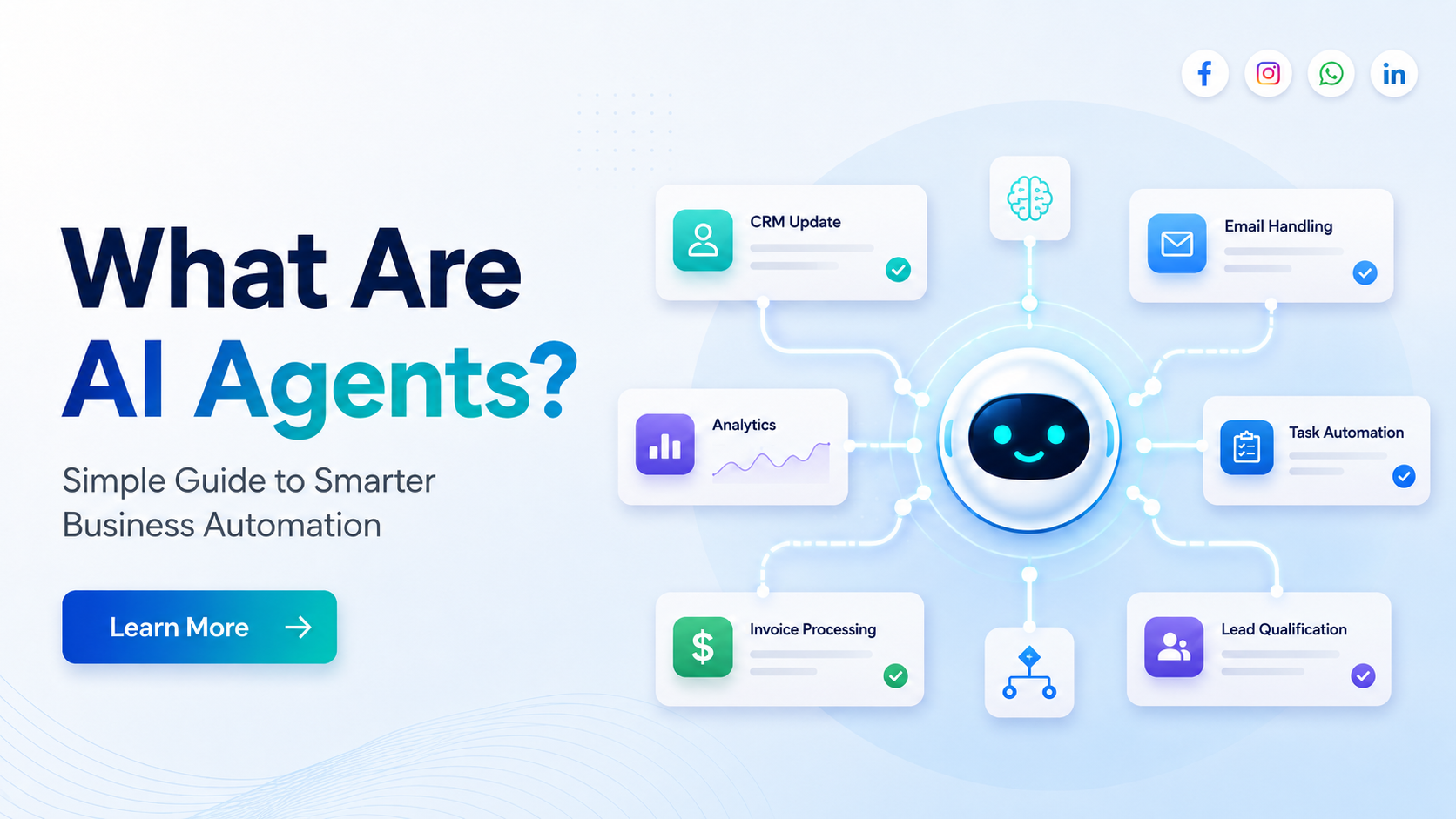
For example, a normal chatbot may answer a customer question. But an AI agent can understand the customer’s issue, check order details, create a support ticket, update the CRM, send a response, and notify the support team.
This is what makes AI agents more useful for business automation.

How Do AI Agents Work?
AI agents work by understanding a goal and then deciding what steps are needed to complete that goal. They usually use AI models, business data, software tools, and automation workflows.
Here is a simple way to understand how AI agents work:
First, the user gives a task or goal. The AI agent understands the request and checks what information or tools are available. Then it plans the next action, performs the task, and provides the result. In some cases, it can also improve its response based on feedback or new data.
For example, if a sales manager asks an AI agent to follow up with inactive leads, the agent can check the CRM, identify leads with no recent activity, prepare follow-up messages, send reminders, and update the lead status.
AI agents become more powerful when they are connected with business systems such as CRM software, ERP software, customer support platforms, ecommerce systems, HRMS software, email tools, and reporting dashboards.
Main Types of AI Agents
There are different types of AI agents based on how they are used. For a business audience, it is better to understand them in a simple way.
Simple task agents are used to complete one specific task, such as sending reminders, checking data, or updating records.
Conversational agents are used to communicate with users, answer questions, and guide them through a process.
Workflow agents help manage repeated business workflows such as lead follow-ups, ticket management, onboarding, approvals, or report generation.
Autonomous agents can make decisions and take actions based on goals, rules, and available data.
Multi-agent systems include multiple AI agents working together. For example, one agent may collect data, another may analyze it, and another may prepare a report.
The right type of AI agent depends on the business process, data availability, and level of automation required.
AI Agents vs Chatbots: What Is the Difference?
Many people think AI agents and chatbots are the same, but they are different.
A chatbot mainly talks with users and answers questions. An AI agent can understand the task, make decisions, use tools, and complete actions.
| Point | Chatbot | AI Agent |
| Main Role | Answers questions | Completes tasks |
| Action Ability | Limited | Can take actions |
| Tool Usage | Basic | Can connect with tools and systems |
| Decision Making | Mostly response-based | More goal-based |
| Business Use | FAQs and support | Automation, CRM, sales, operations, reporting |
For example, if a customer asks about order status, a chatbot may give a basic reply. An AI agent can check the order system, verify the status, generate a response, create a ticket if needed, and update the customer record.
This is why AI agents are becoming more important for businesses that want practical automation.
Examples of AI Agents in Business
AI agents can be used in many business areas. They are especially useful where teams handle repeated tasks, large data, customer requests, or regular follow-ups.
A sales AI agent can track leads, send follow-up reminders, update CRM records, and help the sales team respond faster.
A customer support AI agent can answer customer questions, check ticket status, create new tickets, and route issues to the right department.
An ecommerce AI agent can help customers find products, answer order-related questions, manage return requests, and support personalized recommendations.
An HR AI agent can screen resumes, schedule interviews, answer employee queries, and support onboarding tasks.
A finance AI agent can track invoices, send payment reminders, prepare expense summaries, and support basic financial reporting.
An operations AI agent can monitor daily tasks, prepare reports, alert teams about delays, and help managers improve workflow visibility.
These examples show that AI agents are not only for technology companies. They can support almost every business that uses software and digital systems.
Benefits of AI Agents for Businesses
AI agents can bring strong value when they are planned and implemented correctly. They help businesses reduce manual work, save time, and improve team productivity.
One major benefit is faster response time. AI agents can handle repeated customer questions, lead follow-ups, and internal requests without waiting for manual action.
They also reduce repetitive work for employees. Teams can focus on important tasks while AI agents manage routine updates, reminders, reports, and basic communication.
AI agents can improve decision-making by collecting and analyzing data from different systems. They can help managers see what is happening across sales, support, operations, or finance.
Another important benefit is scalability. As business workload increases, AI agents can handle more tasks without increasing the same level of manual effort.
However, businesses should use AI agents with proper planning, monitoring, and human control, especially for sensitive or high-impact tasks.
Where Can Companies Use AI Agents?
Companies can use AI agents in many software systems and business processes.
In CRM software, AI agents can manage leads, follow-ups, customer communication, and sales pipeline updates.
In ERP software, they can support inventory checks, approvals, purchase requests, and operational reporting.
In customer support software, they can handle tickets, answer FAQs, check customer data, and route issues.
In ecommerce platforms, they can help with product discovery, order status, returns, and customer support.
In SaaS products, AI agents can improve user onboarding, product guidance, analytics, and support automation.
In HRMS software, they can assist with leave requests, attendance queries, employee records, and recruitment workflows.
Industries like healthcare, real estate, logistics, manufacturing, retail, finance, and hospitality can also use AI agents to automate specific workflows.
The best results come when AI agents are connected with the right data, tools, and business logic.
How Are AI Agents Built?
Building AI agents requires more than adding an AI chatbot to a website. A good AI agent should be planned around real business goals and actual workflows.
The first step is to understand what the business wants to automate. This could be lead follow-up, customer support, reporting, invoice reminders, order management, or internal approvals.
After that, the development team identifies the required data sources and software systems. These may include CRM, ERP, database, website, mobile app, email system, or third-party APIs.
Then the right AI model, workflow logic, permissions, and integrations are selected. The AI agent is trained or configured to follow business rules and complete tasks safely.
Testing is very important. The agent should be checked for accuracy, security, response quality, and real-world performance.
A custom AI agent should not be generic. It should match the company’s process, team structure, customer journey, and software environment.
Are AI Agents Safe for Business Use?
AI agents can be safe for business use when they are built with proper controls. The safety of an AI agent depends on how it is designed, what access it has, and how its actions are monitored.
Businesses should use role-based access, data privacy rules, approval flows, and activity tracking. AI agents should only access the data required for their task.
For sensitive tasks, human approval should be included. For example, an AI agent may prepare an invoice, but a finance manager can review and approve it before sending.
AI agents should not be given unlimited control over business systems. Clear rules, permissions, and monitoring are important for safe implementation.
When planned properly, AI agents can support business operations without creating unnecessary risk.

Should Your Business Use AI Agents?
Your business can consider AI agents if your team spends too much time on repeated manual tasks, slow follow-ups, customer queries, reporting, or data updates.
AI agents are useful if you already use systems like CRM, ERP, ecommerce software, HRMS, support software, or internal dashboards but still depend heavily on manual work.
They are also useful when teams use multiple disconnected tools and need better workflow automation.
However, it is not necessary to automate everything at once. A better approach is to start with one clear use case. For example, you can begin with a sales follow-up AI agent, customer support AI agent, or reporting AI agent.
Once the first use case works well, more workflows can be automated step by step.
Conclusion
AI agents are intelligent software systems that can understand goals, make decisions, use tools, and complete tasks. They are more advanced than basic chatbots because they can take action and support real business workflows.
For businesses, AI agents can improve productivity, customer support, sales, operations, reporting, and workflow automation.
The best results come when AI agents are custom-built around real business needs. If your company wants to automate workflows, improve team efficiency, or build AI-powered software, a professional software development team can help you plan and develop the right AI agent solution.
FAQs
Q1. What are AI agents in simple words?
AI agents are smart software systems that can understand a task, make decisions, use tools, and complete actions with less manual effort.
Q2. How do AI agents work?
AI agents work by understanding a goal, checking available data, planning the next action, using connected tools, and completing the task.
Q3. What is the difference between AI agents and chatbots?
A chatbot mainly answers questions, while an AI agent can take actions, connect with systems, update data, and complete business tasks.
Q4. How can businesses use AI agents?
Businesses can use AI agents for sales follow-ups, customer support, CRM updates, ecommerce support, HR tasks, finance reminders, and workflow automation.
Q5. Can AI agents be custom-built for business software?
Yes, AI agents can be custom-built for CRM, ERP, ecommerce platforms, SaaS products, HRMS, customer support systems, and internal business workflows.