
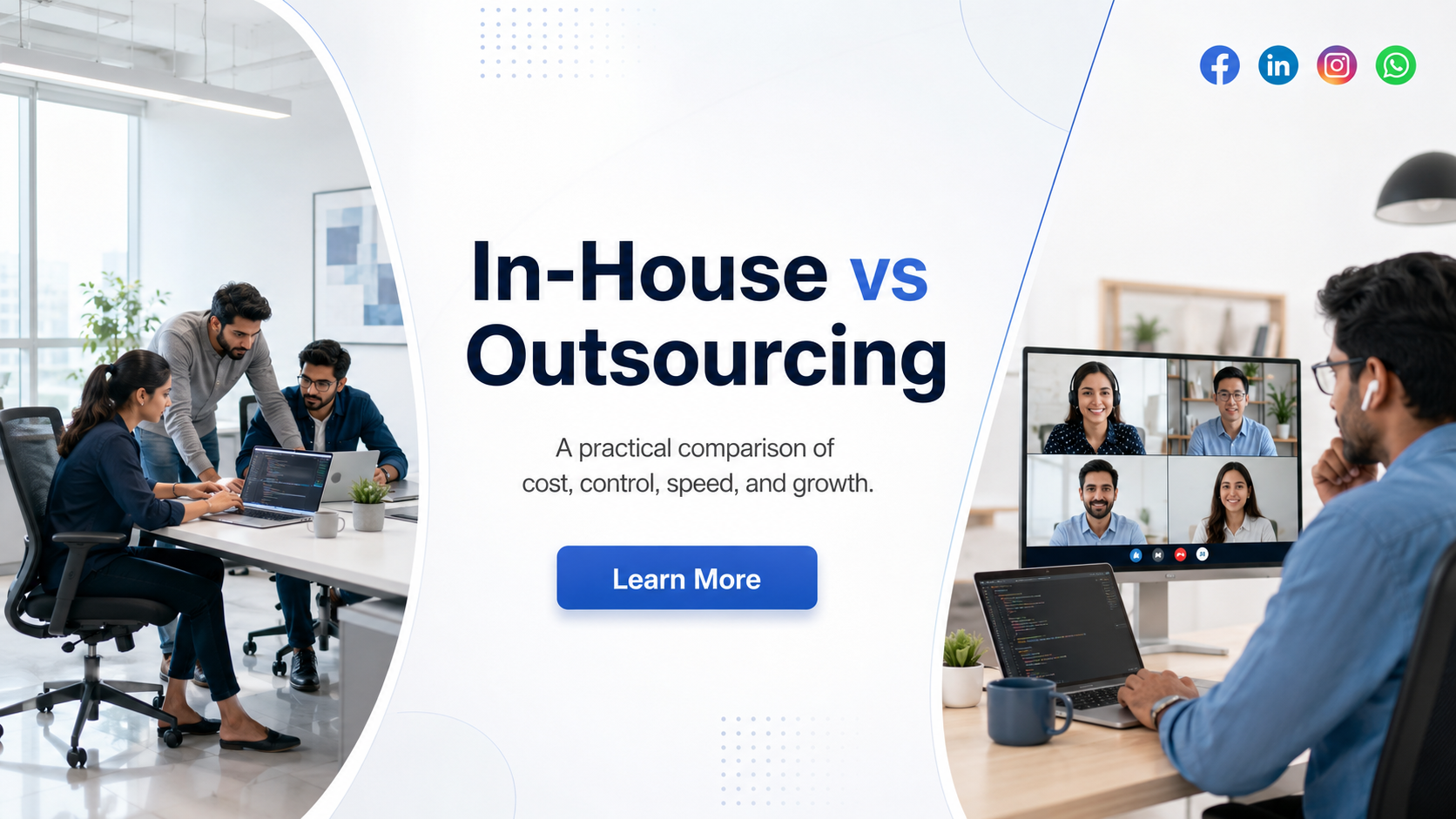
When a business plans to build software, one important question comes first: should you build an in-house development team or outsource the project to a software development company?
This decision can affect your budget, project speed, software quality, team control, long-term support, and business growth. Many businesses make the mistake of choosing only based on cost, but the real decision is much deeper than that.
In-house development and outsourcing both can work well. The right choice depends on your business goal, project size, budget, timeline, technical skills, and how important the software is for your business.
This guide explains the full comparison between in-house development vs outsourcing in a simple and practical way, so you can decide which model is better for your business.
Quick Answer: Which One Should You Choose?
Choose in-house development if software is your core product, you need full internal control, and you are ready to invest in hiring, salaries, infrastructure, management, and long-term technical leadership.
Choose outsourcing if you want faster execution, flexible cost, access to experienced developers, and a ready team without going through the full hiring process.
For many startups, SMEs, and growing businesses, outsourcing is often a practical choice in the beginning. It helps them build software faster without creating a full technical department. Later, when the software becomes stable and business-critical, they may build an internal team or use a hybrid model.
What Is In-House Software Development?
In-house software development means the company hires its own developers, designers, testers, project managers, and technical team to build and maintain software internally.
The team works directly under the company. They understand the company’s internal process, goals, customers, and product direction. This gives the business more control over daily decisions, changes, and long-term software planning.
For example, if a SaaS company is building its main product, it may prefer an in-house development team because the software is directly connected to its business model, customer experience, and future growth.
In-house development is usually suitable for companies that need continuous software improvement, strong internal control, and long-term product ownership.

What Is Software Development Outsourcing?
Software development outsourcing means hiring an external software development company or dedicated development team to build your software.
The outsourced team can handle planning, UI/UX design, development, testing, deployment, integration, and post-launch support. Businesses usually outsource when they do not have an internal tech team, need faster development, or want access to specific technical skills.
For example, a logistics company may need a delivery tracking system, CRM, dashboard, or automation software. Instead of hiring developers, designers, testers, and managers separately, the company can outsource the project to an experienced software development team.
Outsourcing is commonly used for custom software development, web applications, mobile apps, CRM systems, ERP software, automation tools, dashboards, booking platforms, and business management systems.
In-House Development vs Outsourcing: Quick Comparison
| Factor | In-House Development | Outsourcing |
| Initial Cost | High | More flexible |
| Hiring Time | Slow | Faster |
| Control | Full internal control | Depends on vendor process |
| Talent Access | Limited to hired team | Access to wider skills |
| Speed | Slower if team is not ready | Faster with ready team |
| Scalability | Takes time and cost | Easier to scale |
| Management Effort | High | Lower if vendor manages delivery |
| Security | Strong internal control | Requires NDA and access control |
| Best For | Core products and long-term systems | MVPs, business software, scaling, and specialized projects |
This table gives a quick understanding, but the real decision depends on your business situation. Cost, speed, control, talent, and long-term support must be checked together.
Cost Comparison: In-House Development vs Outsourcing
Cost is one of the biggest reasons businesses compare in-house development and outsourcing. But the mistake many companies make is comparing only developer salary with outsourcing cost.
That is not the correct comparison.
In-house development cost is not only salary. It also includes recruitment, HR, payroll, training, office setup, software tools, project management, testing, infrastructure, employee replacement, and long-term retention.
When you hire an in-house team, you carry a fixed monthly cost whether the workload is high or low. If one developer leaves, the project may slow down. If you need a new skill, you have to hire again or train your team.
Outsourcing works differently. You usually pay based on project scope, timeline, development phase, or team size. This gives more flexibility, especially when you do not need every skill full-time.
For example, one software project may need UI/UX design in the beginning, backend development during the main phase, QA testing near delivery, and DevOps during deployment. In outsourcing, you can use these skills as needed. In an in-house model, hiring all these people permanently can become expensive.
So, if your software need is project-based or not continuous every day, outsourcing can be more cost-effective. But if software is your main product and needs daily improvements for years, in-house development may become more practical in the long run.
Speed and Execution: Which Model Is Faster?
Speed matters when a business wants to launch quickly, test an idea, automate operations, or build software before competitors move ahead.
In-house development can take more time if you are starting from zero. You need to find developers, interview them, hire them, onboard them, set up systems, define processes, and manage the team. Good developers are not always easy to hire quickly, especially if your project needs multiple skills.
Outsourcing can be faster because the software development company already has a team, process, tools, designers, developers, testers, and project managers. The project can usually start faster once the scope is clear.
This is why outsourcing is often useful for MVP development, business software, mobile apps, CRM, ERP, portals, dashboards, automation systems, and internal tools.
However, faster does not mean careless. Outsourcing gives speed only when the requirements are clear, communication is structured, and milestones are properly defined.
Control and Communication: Where In-House Has an Advantage
One strong advantage of in-house development is direct control.
Your team works inside your company. You can discuss changes quickly, manage priorities directly, and involve the team in internal meetings. The developers understand your business culture, users, workflow, and long-term goals more closely.
This is useful when the software needs daily changes, deep business knowledge, or fast internal decision-making.
But there is one important point. Control is useful only when you have the right technical leadership. If a business owner hires developers but does not know how to manage technical planning, code quality, timelines, testing, and architecture, the in-house team can still become slow and expensive.
So, in-house development gives more control, but it also needs strong management.
Outsourcing needs clear communication. The business should define requirements, expected outcomes, timelines, responsibilities, review process, and approval flow. If communication is weak, outsourcing can create confusion. If communication is strong, it can work smoothly.
Talent and Skill Availability
Software development is not only about coding.
A good software project may need business analysis, UI/UX design, frontend development, backend development, mobile app development, database planning, API integration, cloud setup, testing, security, deployment, and support.
It is difficult for one small in-house team to have all these skills. Even if you hire good developers, they may not be experts in every area.
Outsourcing gives access to a wider skill set. A software development company usually has different people for different stages of the project. This helps businesses get the right skill at the right time without hiring everyone permanently.
This is especially useful for small businesses and growing companies that need professional software but do not want to build a full technical department from the beginning.
Security and Ownership: What Businesses Must Check
Security is an important part of the in-house development vs outsourcing decision.
Many businesses think in-house development is always safer. In some cases, that can be true because the team works directly under the company and access can be controlled internally.
But outsourcing can also be safe if the process is handled properly.
Before outsourcing software development, businesses should clearly check NDA, source code ownership, IP rights, data access, admin permissions, Git repository access, documentation, hosting access, and post-launch support terms.
The business should make sure that the final source code, design files, documentation, login credentials, and project assets are properly handed over.
Security is not only about where the team sits. It depends on process, access control, agreements, documentation, and professional development practice.
Quality and Accountability
Quality problems can happen in both models.
An in-house team can deliver poor quality if there is no technical leadership, no testing process, no code review, and no clear roadmap. An outsourced team can also create problems if the vendor is inexperienced, requirements are unclear, or communication is weak.
The real quality difference comes from planning, process, experience, testing, documentation, and accountability.
In-house quality depends on your internal hiring quality and management capability. Outsourcing quality depends on vendor experience, project understanding, milestone tracking, communication, and testing standards.
A good outsourced development team should not only write code. They should understand your business problem, suggest practical solutions, document the work, test properly, and support the software after launch.
Scalability: Which Model Is Easier to Expand?
Scalability means how easily you can increase or reduce your development capacity.
With an in-house team, scaling takes time. If you need more developers, you have to hire them. If you need a designer, tester, DevOps engineer, or mobile app developer, you have to find and onboard them. This increases fixed cost.
With outsourcing, scaling is usually easier. You can increase or reduce the team size depending on the project phase. If the project needs faster development, more resources can be added. If the work slows down after launch, the team size can be reduced.
This flexibility is useful for businesses where software requirements are not the same every month.
If your workload is stable for many years, an in-house team can make sense. But if your project needs change from time to time, outsourcing gives better flexibility.
When Should You Choose In-House Development?
In-house development is a good choice when software is central to your business.
For example, if you are building a SaaS product, fintech platform, large enterprise product, or technology-based business, your software is not just a support tool. It is the main business asset.
In such cases, having an internal team can help you control product direction, user experience, security, and long-term innovation.
You should choose in-house development when you have enough budget, technical leadership, long-term development needs, and the ability to manage hiring and retention.
In simple words, in-house development is better when software is your business, not just a business tool.
When Should You Choose Outsourcing?
Outsourcing is a strong choice when you need software but do not want to build a full internal technical team.
This is common for businesses that need custom software, CRM, ERP, mobile apps, web applications, dashboards, automation systems, booking systems, inventory software, or customer portals.
For example, a manufacturing company may need inventory management software. A logistics company may need delivery tracking software. A real estate company may need a CRM. A service business may need an internal workflow system.
In these cases, software is important for business growth, but the company may not need a full-time internal development team. Outsourcing helps them build the solution faster and with better cost control.
Outsourcing is also useful when you need specialized skills for a limited period. Instead of hiring multiple people permanently, you can work with a software development company that already has the required team.

Is Hybrid Development the Best Option?
Many businesses do not need to choose only one model. A hybrid model can be the most practical approach.
In a hybrid model, the company keeps product ownership, strategy, and major decisions internally, while outsourcing development, UI/UX, testing, integrations, or maintenance.
This gives the business both control and flexibility.
For example, a company may have one internal product manager or technical head, but outsource the actual development work to an external team. This keeps business direction inside the company while using external developers for faster execution.
A hybrid model is useful for startups, SMEs, and enterprises that want control but do not want to handle the full hiring pressure.
Common Mistakes Businesses Make While Choosing
One common mistake is choosing only based on cost. The cheapest option can become expensive if quality is poor, communication is weak, or the software needs too much rework.
Another mistake is hiring an in-house team without technical leadership. Developers need proper planning, review, testing, and direction. Without that, the project may move slowly even if the team is internal.
Some businesses outsource without clear requirements. This can create scope confusion, delays, extra cost, and quality issues.
Another big mistake is ignoring post-launch support. Software does not end after launch. It needs bug fixes, security updates, user improvements, performance checks, and future enhancements.
Businesses should also never ignore code ownership. Whether you choose in-house or outsourcing, make sure your business has proper ownership of the source code, documentation, and project assets.
Decision Checklist Before You Choose
Before choosing between in-house development and outsourcing, ask yourself these questions:
- Is software my core business or a support system?
- Do I need daily development or project-based development?
- Do I have technical leadership?
- What is my budget for the next 12 months?
- How fast do I need to launch?
- Do I need specialized skills?
- Can I manage hiring and retention?
- Do I need long-term support?
- How sensitive is my data?
- Do I need flexibility to scale the team?
These questions will help you make a better decision instead of choosing based on assumptions.
Final Recommendation: Which One Is Better?
There is no fixed answer for every business.
In-house development is better when software is your core product, you need full control, and you are ready for long-term investment in people, tools, management, and technical leadership.
Outsourcing is better when you need faster execution, flexible cost, access to experienced developers, and a complete team without hiring internally.
For many businesses, the best approach is to start with outsourcing or a hybrid model. This helps them build and launch faster. Later, when the software becomes stable and needs continuous long-term improvement, they can build an in-house team if required.
The right decision is not about which model is popular. It is about which model fits your business goal, budget, timeline, and technical capability.
Need Help Choosing the Right Software Development Model?
Choosing between in-house development and outsourcing can be confusing if you are planning to build custom software for your business.
If you need a web application, mobile app, CRM, ERP, automation system, dashboard, portal, or complete business management software, working with an experienced software development team can help you plan the right approach from the beginning.
A proper discussion can help you understand whether you need a full outsourced team, dedicated developers, or a hybrid development model.
If you are planning your next software project, you can start with a free software consultation and choose the model that fits your business properly.


